



Top ranked big -law firms are often described as if they draw from the same talent pool in roughly the same way. They recruit from selective law schools, hire former clerks, maintain offices in major legal markets, and staff a mix of corporate, litigation, regulatory, and appellate matters. From the outside, the differences among firms can blur into a single category: big-law prestige.
But the public rosters tell a more textured story.
For this analysis, I worked with a research assistant to collect attorney biographies from each lawyer’s page on the websites of five firms: Skadden, Sullivan & Cromwell, Davis Polk, Gibson Dunn, and Milbank. We pulled the information listed on each public bio, including attorney title, office, law school, clerkships, courts, judges, practice areas, and contact fields, then normalized the data across firms so the same fields could be compared firm by firm. The unit of analysis is the publicly listed attorney biography, not an internal personnel record, so the results reflect what each firm chooses to disclose on its website.
That limitation matters. Some firms provide more complete educational or clerkship detail than others. Graduation-year data, in particular, is too incomplete to support meaningful cross-firm comparisons. But the core fields—firm, title, office, law school, clerkship status, court type, and broad practice bucket—are strong enough to reveal several patterns.
The first pattern is scale. The five rosters vary considerably in size:
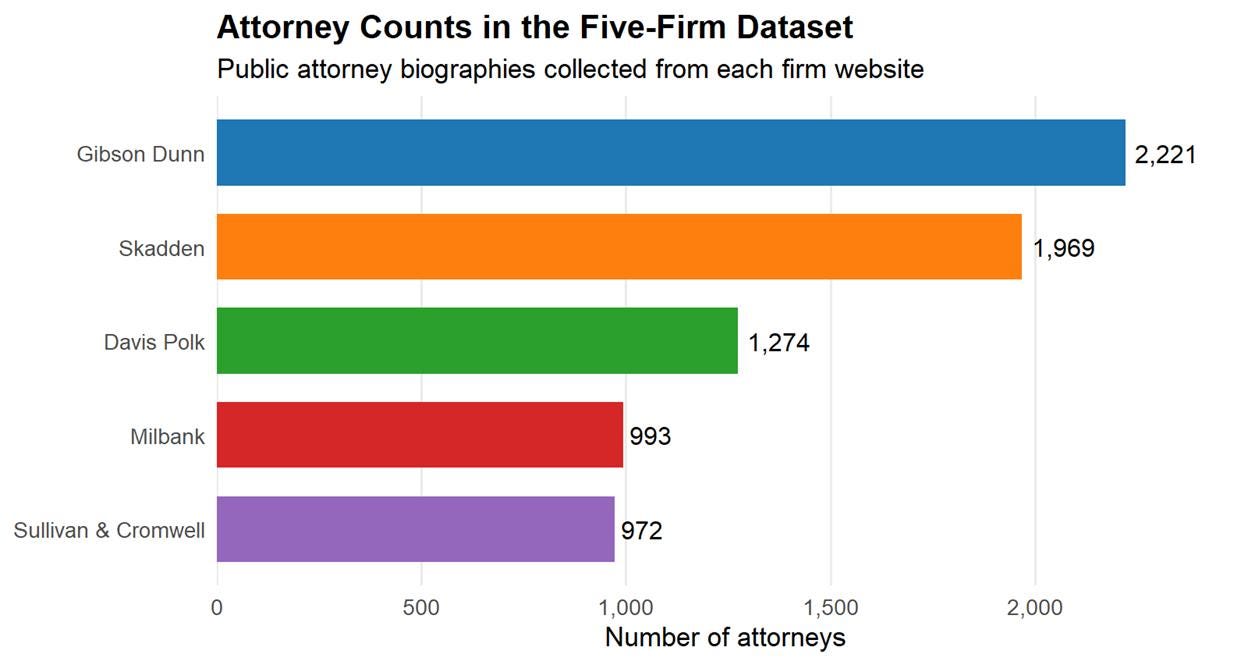
The size differences shown in the figure shape the rest of the analysis. A larger roster will naturally produce more raw observations: more former clerks, more graduates of particular law schools, more offices represented, and more practice labels. But raw totals are not the same as institutional concentration.
For that reason, the comparisons that follow rely primarily on firm-level percentages rather than simple counts. The goal is to ask not just how many attorneys at a firm have a particular credential, but how central that credential appears within the firm’s public roster.
The sections that follow examine several dimensions of elite-firm identity. First, the analysis compares clerkship patterns, including overall clerkship rates and the distribution of Supreme Court, federal appellate, and district court clerkships. It then turns to law-school pipelines, looking both at broader elite-school categories and at the top feeder schools for each firm. The article then considers office geography, because a firm’s New York, Washington, California, London, and international footprints may help explain credential patterns. Finally, it groups practice descriptions into common buckets so that firm-specific labels can be compared more directly.