

Breaking Down the Text in SCOTUS' Birthright Citizen Decision
The justices' focal points become readily apparent with text-based comparisons.

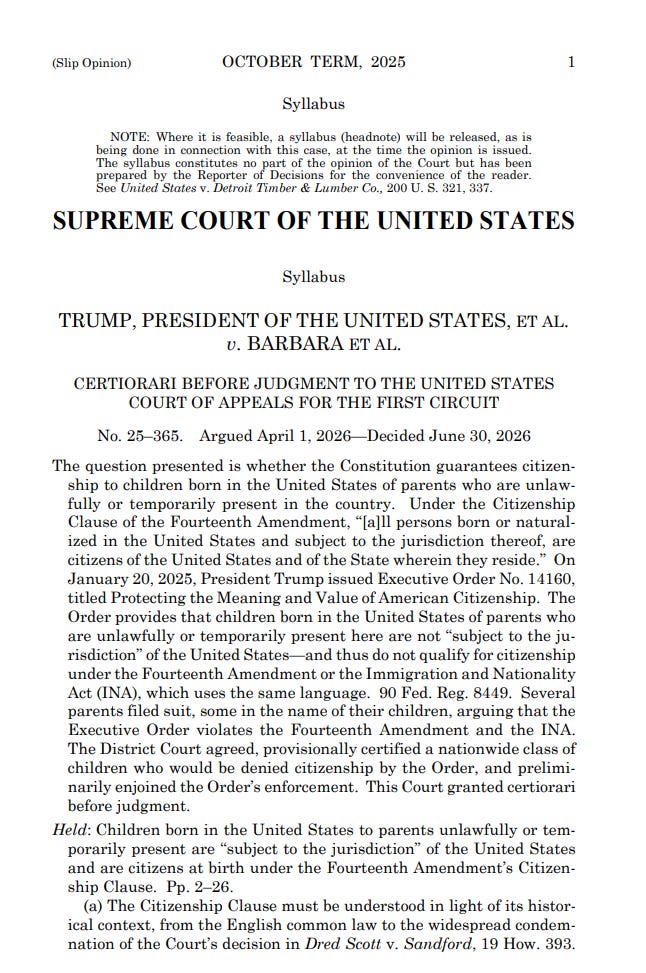
Trump v. Barbara, the birthright-citizenship case that dominated headlines this term, was emblematic of how the Court can be predictable in closely followed cases while still leaving room for surprises. Many observers, including me, expected the Court to reject the Trump administration’s order ending birthright citizenship. Based on oral argument, I predicted that Justices Thomas and Alito would dissent, and that Justice Barrett would be the pivotal vote. Thomas and Alito did dissent, Barrett joined the majority, and Justice Gorsuch also dissented. Justice Kavanaugh wrote separately, concurring in the judgment in part and dissenting in part, but he did not join the Thomas, Alito, or Gorsuch dissents.
The opinions reflect three divergent accounts of constitutional membership. The Roberts majority treated birth in the United States, coupled with subjection to U.S. sovereign authority, as enough to establish citizenship under the Fourteenth Amendment. The principal dissents focused on a more demanding concept of allegiance, especially for children of temporary visitors and unlawfully present parents. Justice Kavanaugh’s middle position would have upheld the injunction for the plaintiff class but avoided the majority’s broader constitutional holding as to every child of unlawfully or temporarily present parents.
The outcomes, however, are only part of the story. The justifications and rationales in the opinions lead to how the opinion outcomes were reached. The opinions also differ sharply in length, vocabulary, precedent use, and conceptual structure. The following breaks down these elements.
Opinion Lengths
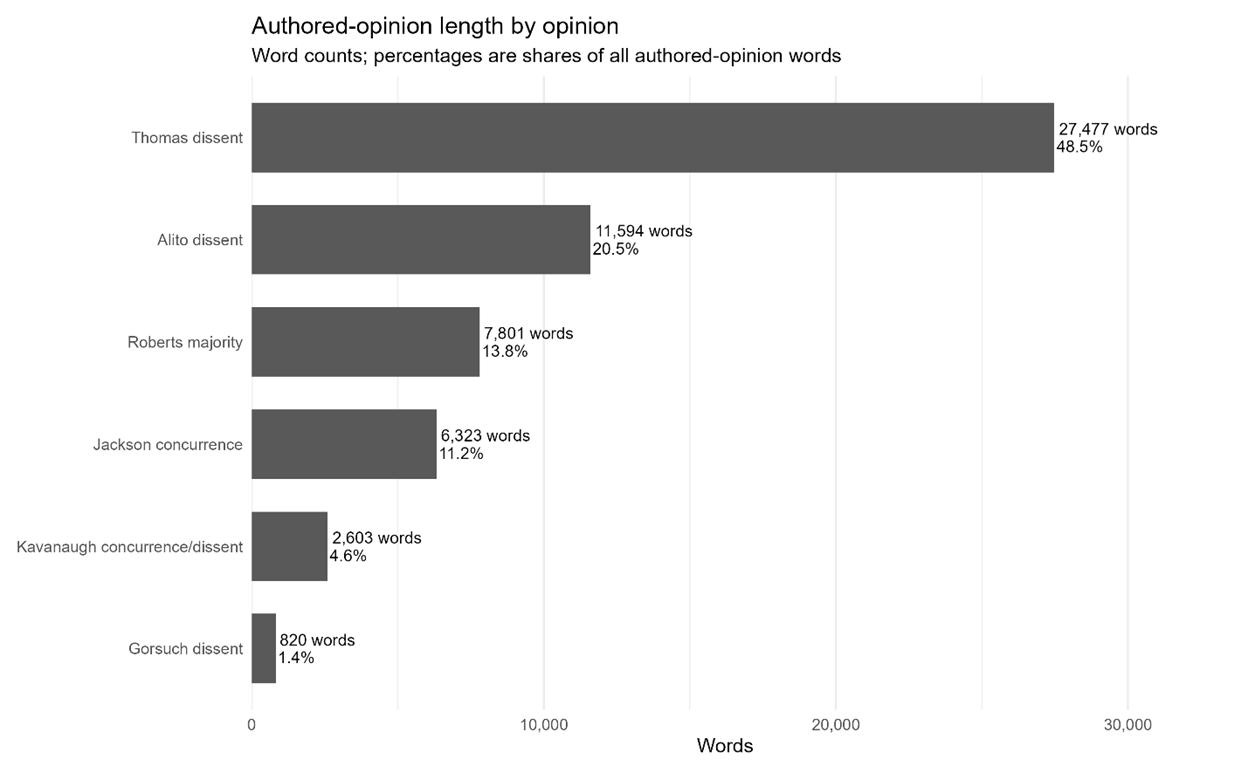
The length distribution shows how much of the case’s written law is in dissent. The Roberts majority was 7,801 words, or 13.8% of all authored-opinion words. The Thomas dissent alone was 27,477 words, or 48.5% of the authored-opinion total. Alito added another 11,594 words, or 20.5%, and Gorsuch added 820 words, or 1.4%. Together, the three dissents accounted for 39,891 words, approximately 70.5% of the authored text.
That imbalance affects how the decisions flow. The controlling opinion is relatively compact, while the dissents supply most of the historical excavation and counter-history. Thomas’s dissent was more than three-and-a-half times the length of the Roberts majority. The Jackson concurrence, at 6,323 words, was almost as long as the majority itself, while Kavanaugh’s separate opinion was much shorter at 2,603 words.
Concepts
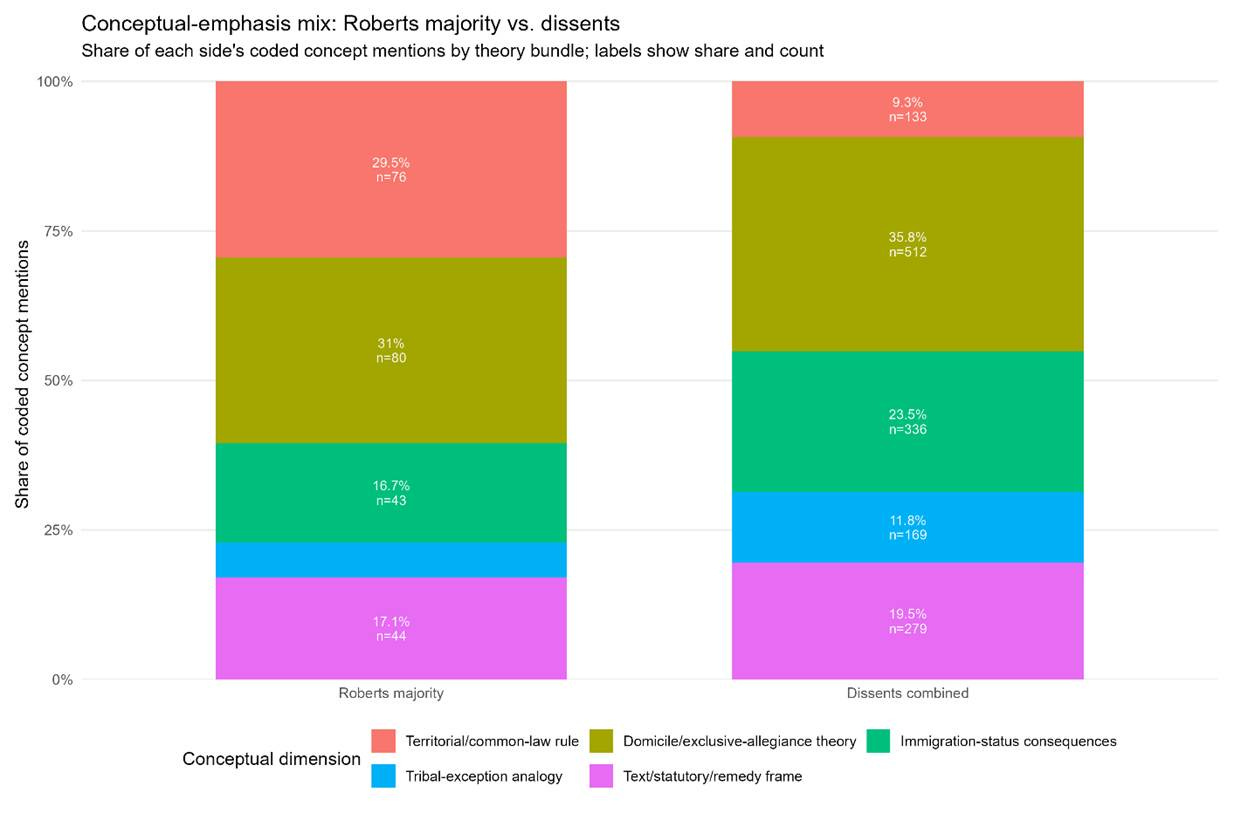
The conceptual-emphasis graph groups terms into broader theory bundles rather than counting individual words in isolation. The sharpest difference is the territorial/common-law frame. In the Roberts majority, territorial/common-law terms accounted for 29.5% of coded concept mentions, with 76 mentions. In the dissents, the same bundle accounted for only 9.3%, with 133 mentions.
The dissents devoted a larger share of their coded vocabulary to domicile, exclusive allegiance, immigration status, and tribal-exception analogies. Domicile/exclusive-allegiance terms made up 35.8% of the dissent-side concept mix, with 512 mentions, compared with 31.0% and 80 mentions in the Roberts majority. Immigration-status terms were also more prominent in the dissents: 23.5% of coded dissent mentions, compared with 16.7% in the majority. Tribal-exception terms doubled as a share of the dissent-side mix, from 5.8% in the majority to 11.8% in the dissents.
Term Counts in Opinions Relative to Oral Arguments
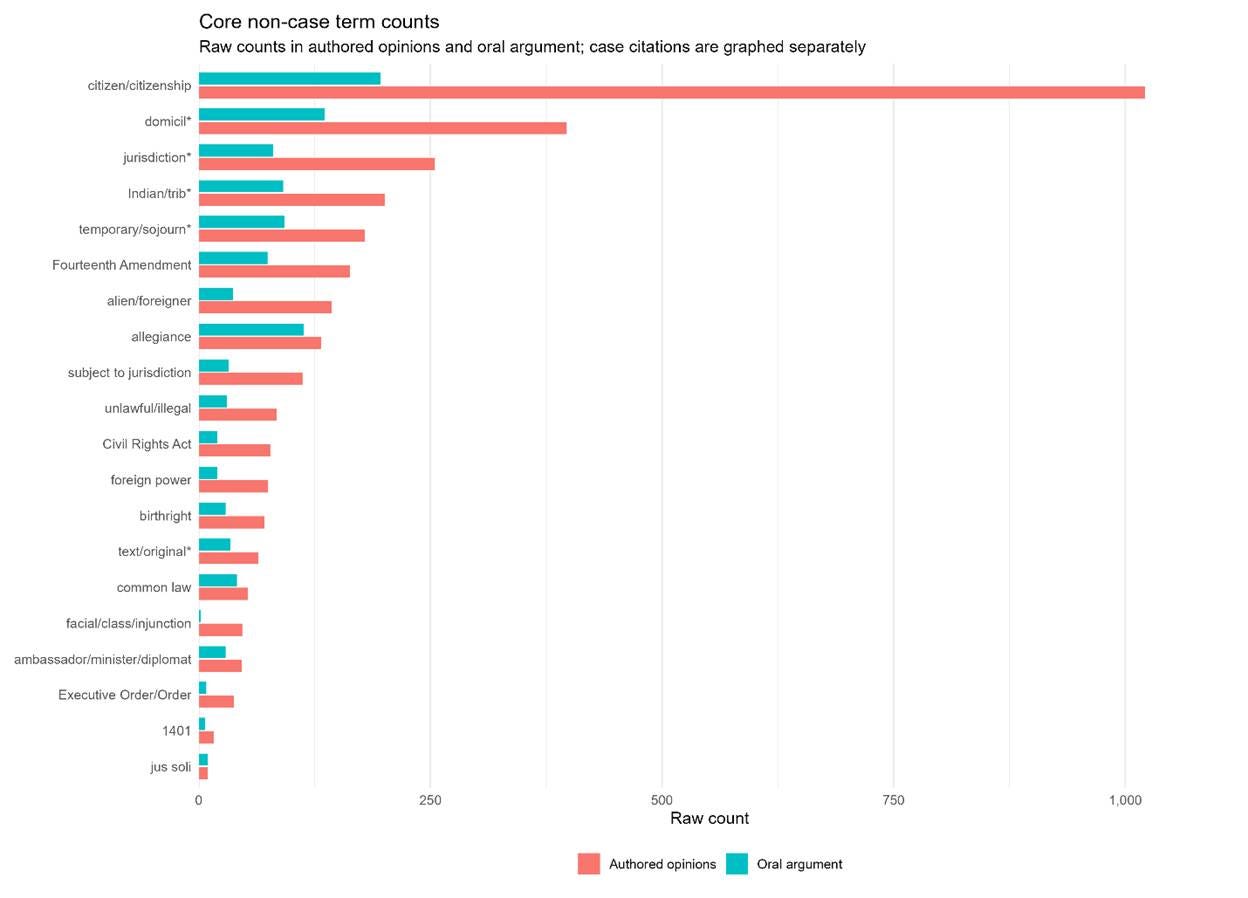
The raw term counts show the vocabulary that dominated both the opinions and the argument. Across the authored opinions, citizen/citizenship appeared 1,021 times, far more than any other term family. Domicile-related terms were next at 397, followed by jurisdiction at 255, Indian/tribal terms at 201, temporary/sojourn at 179, and Fourteenth Amendment at 163.
The oral argument anticipated many of those same terms. Citizen/citizenship appeared 196 times at argument, domicile 136 times, allegiance 113 times, temporary/sojourn 92 times, Indian/tribal terms 91 times, and jurisdiction 80 times. Allegiance was especially argument-heavy: it appeared 113 times at argument and 132 times in the authored opinions, making it one of the terms most intensively tested at argument relative to its later written footprint.
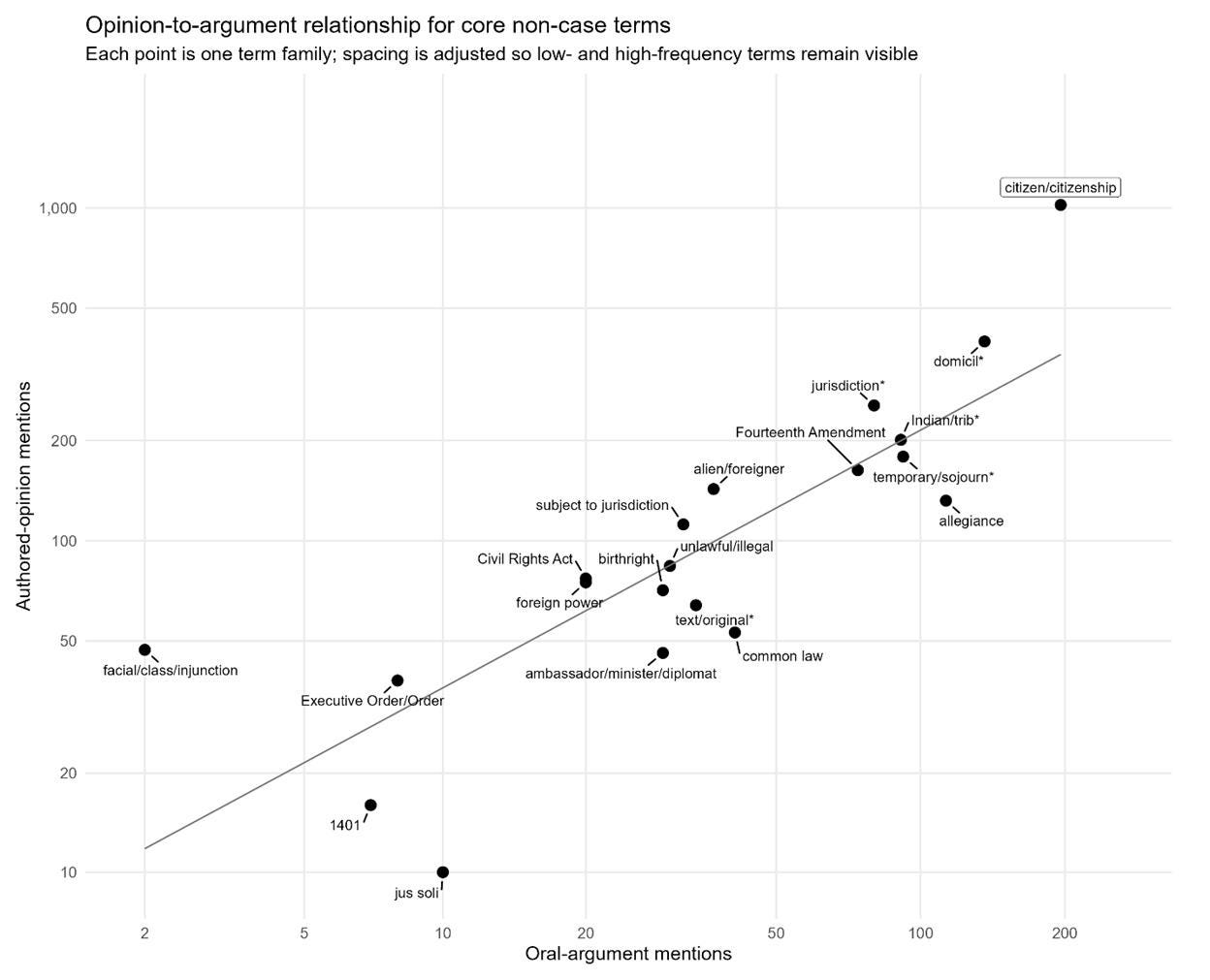
The opinion-to-argument relationship graph also shows that the topics receiving the most attention at argument were generally the same topics that dominated the opinions. The line across the graph shows the average relationship between term use in the opinions relative to oral arguments across all terms shown in the graph. Several terms stand out. Citizen/citizenship sits at the top of both the argument and opinion counts, with 196 oral-argument mentions and 1,021 authored-opinion mentions. Domicile also carried over strongly from argument to opinion, with 136 argument mentions and 397 opinion mentions. By contrast, common law appeared 41 times at argument and 53 times in the opinions, reflecting a term that was central to the majority’s reasoning but did not dominate the overall written record in raw-count terms.
Term Use in Majority and Dissenting Opinions
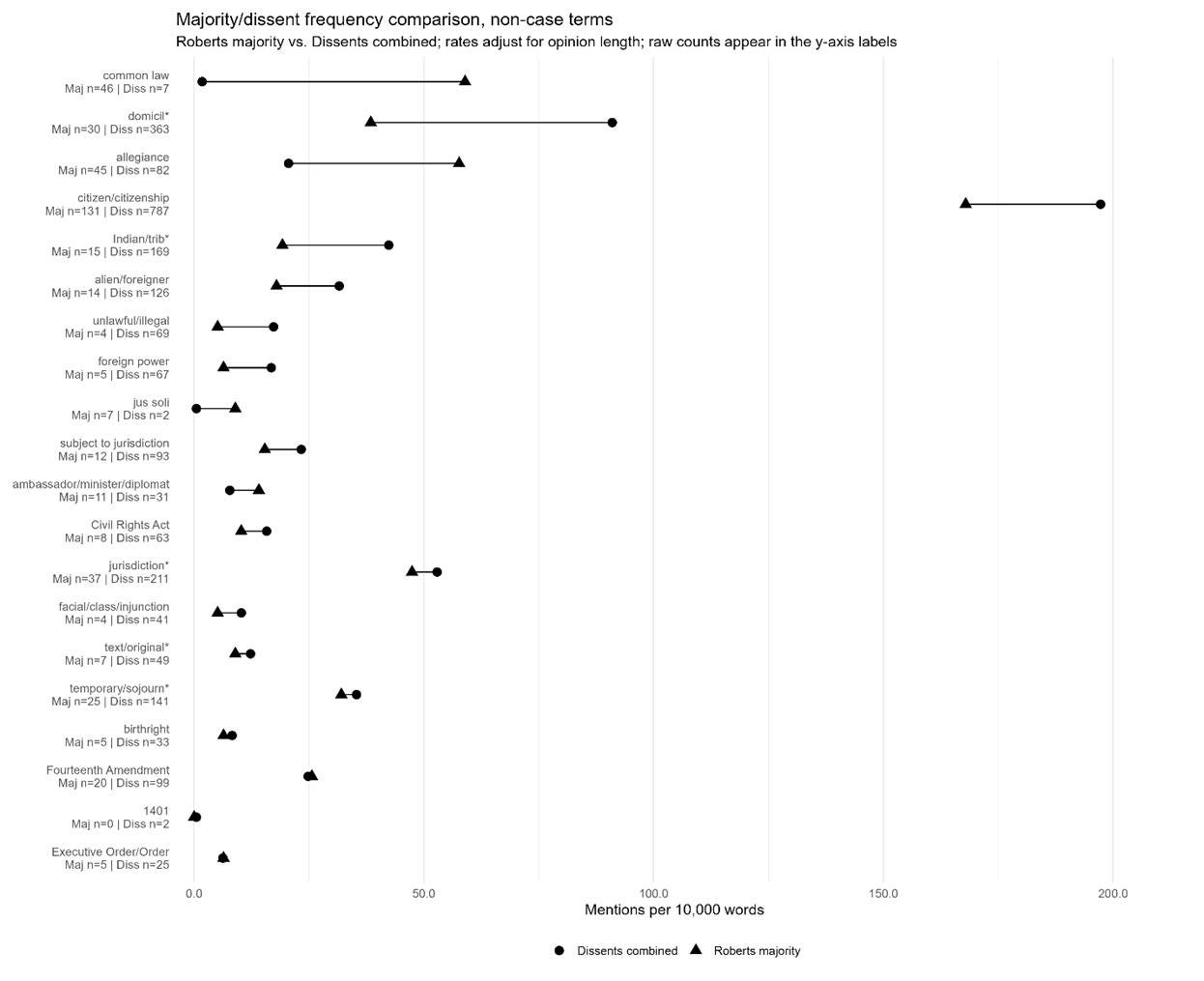
The majority/dissent frequency comparison shows where the Roberts majority and the dissents diverged most after adjusting for opinion length. The Roberts majority used common-law terms at 59 mentions per 10,000 words, compared with only 1.8 per 10,000 words in the combined dissents. Jus soli (Latin for “right of the soil”) showed the same directional pattern: 9 per 10,000 words in the majority, compared with 0.5 in the dissents.
The dissents moved in the opposite direction on domicile and immigration-status language. Domicile-related terms appeared 363 times in the combined dissents, or 91 per 10,000 words, compared with 30 times in the Roberts majority, or 38.5 per 10,000 words. Indian/tribal terms appeared at 42.4 per 10,000 words in the dissents, compared with 19.2 in the majority. Unlawful/illegal terms appeared at 17.3 per 10,000 words in the dissents, compared with 5.1 in the majority. Foreign-power terms appeared at 16.8 per 10,000 words in the dissents, compared with 6.4 in the majority.
Allegiance is the notable counterexample. The Roberts majority used allegiance more intensively than the dissents: 45 mentions, or 57.7 per 10,000 words, compared with 82 dissent mentions, or 20.6 per 10,000 words. That supports the point that the majority did not avoid allegiance; it defined allegiance through birth, protection, and territorial jurisdiction rather than through parental domicile or exclusive national allegiance.
Precedent Use Across Opinions
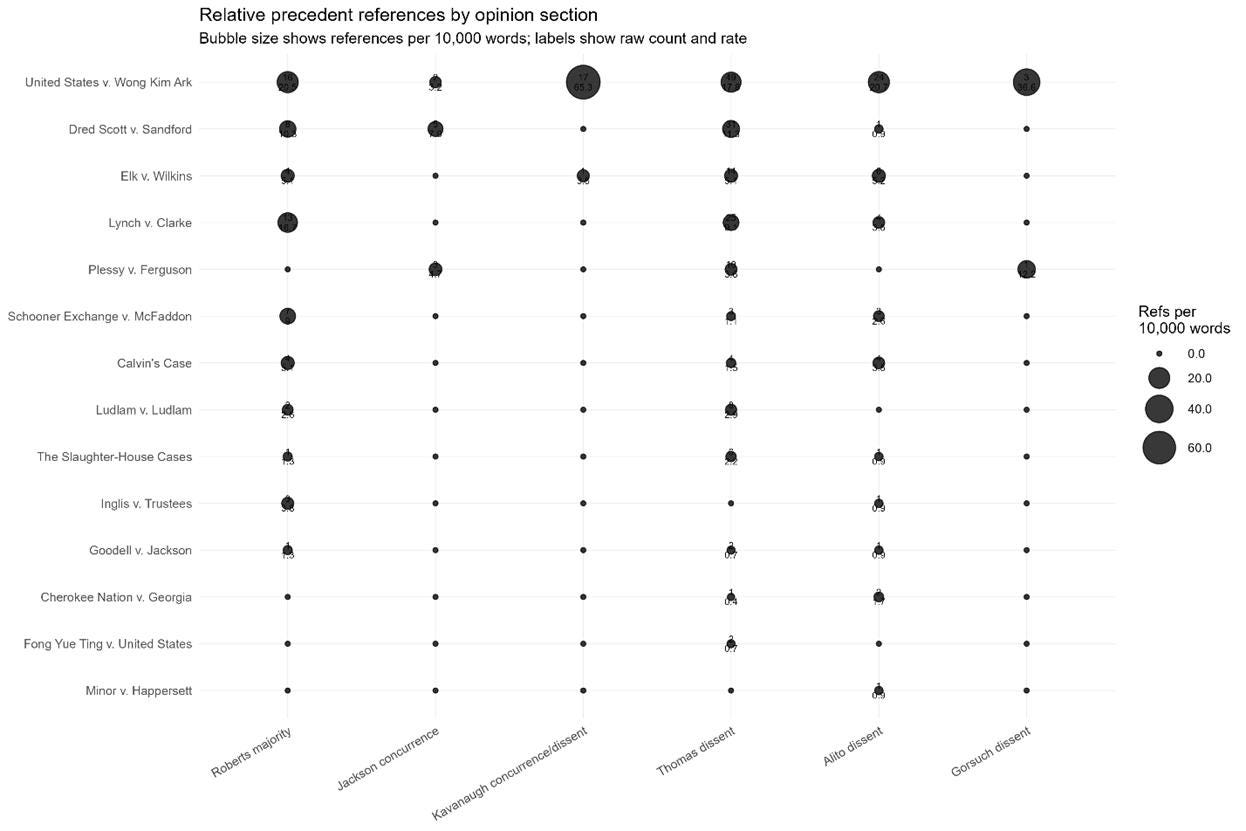
The precedent-reference graph shows that Wong Kim Ark was the central authority across the case, but each opinion used it differently. The Roberts majority cited or referenced Wong Kim Ark 16 times, or 20.5 references per 10,000 words. Thomas referenced it 49 times, or 17.8 per 10,000 words. Alito referenced it 24 times, or 20.7 per 10,000 words. Kavanaugh’s separate opinion had the highest relative rate: 17 references in only 2,603 words, or 65.3 per 10,000 words.
The other precedents reveal the opinions’ different historical emphases. The Roberts majority relied heavily on Lynch v. Clarke, with 13 references, and Schooner Exchange, with 7. Thomas’s dissent cited Dred Scott 31 times and Lynch 25 times, while also leaning on Elk v. Wilkins 14 times. Jackson’s concurrence was more Reconstruction- and caste-focused, with 5 references to Dred Scott and 3 to Plessy. Gorsuch’s short dissent referenced Wong Kim Ark 3 times and Plessy once.
Majority-Dissent Relative Precedent Use
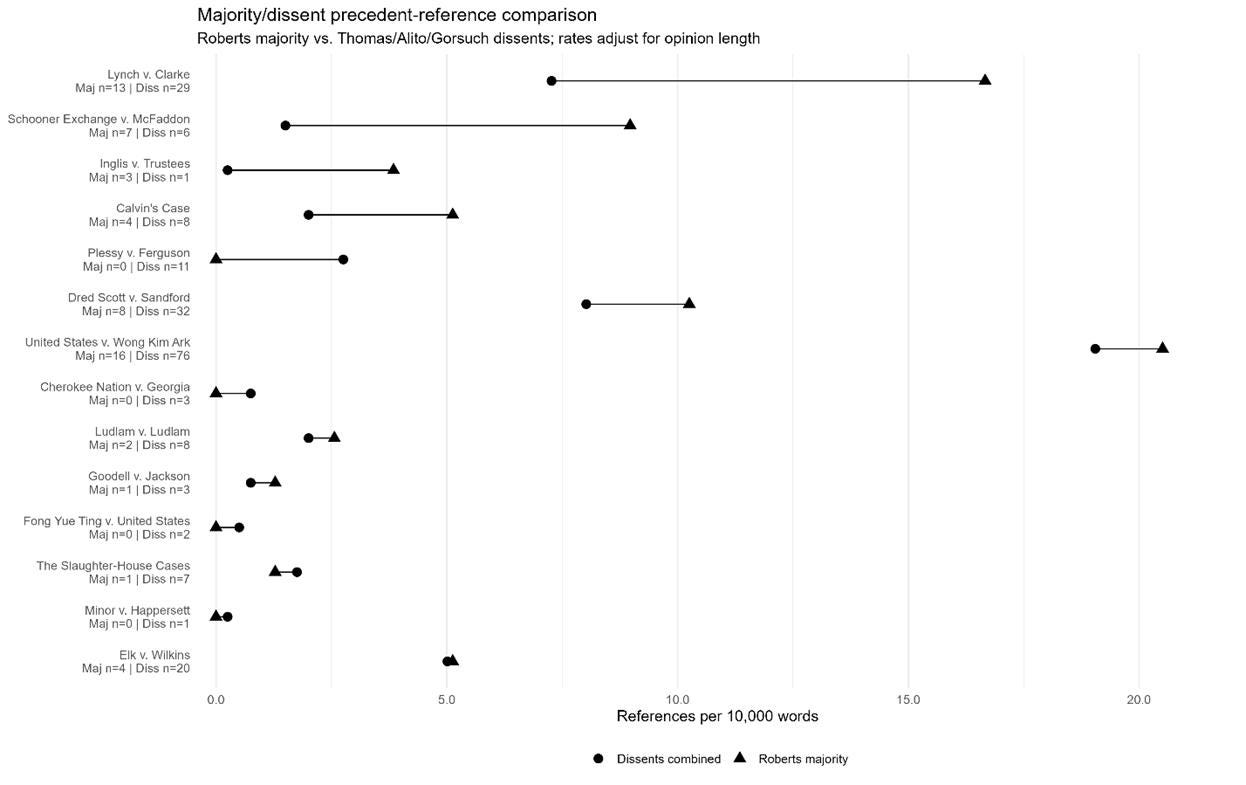
The majority/dissent precedent comparison sharpens the split in authority. Wong Kim Ark was almost evenly weighted after adjusting for opinion length: 20.5 references per 10,000 words in the Roberts majority and 19.1 in the combined Thomas, Alito, and Gorsuch dissents. That makes it the shared center of the case rather than a precedent owned by either side.
The divide appears in the supporting precedents. The Roberts majority referenced Lynch v. Clarke at 16.7 per 10,000 words, compared with 7.3 in the dissents. It referenced Schooner Exchange at 9 per 10,000 words, compared with 1.5 in the dissents. The majority also used Calvin’s Case at a higher relative rate, 5.1 per 10,000 words compared with 2 in the dissents. The dissents, meanwhile, more frequently invoked Plessy, with 11 references across the combined dissents and compared to none in the Roberts majority. Elk v. Wilkins was nearly even by rate, at 5.1 per 10,000 words in the majority and 5.0 in the dissents, reflecting its importance to both sides’ treatment of the tribal-citizenship exception.
Summing It Up
The textual split in Trump v. Barbara tracks the jurisprudential split. The Roberts majority is compact and rule-oriented, with its distinctive vocabulary clustered around common law, jus soli, territorial jurisdiction, and a version of allegiance grounded in sovereign protection. That pattern shows a majority opinion organized around continuity: the Citizenship Clause is treated as carrying forward a settled birth-on-soil principle, with narrow historical exceptions. The dissents are much longer and more reconstructive. Their language shifts heavily toward domicile, foreign allegiance, immigration status, and the tribal-citizenship exception, reflecting an effort to rebuild the doctrine around a more bounded conception of national membership.
The precedent patterns point in the same direction. Both sides return repeatedly to Wong Kim Ark, which functions as the shared center of gravity rather than as a one-sided authority. The disagreement lies in the surrounding architecture. The majority’s supporting citations emphasize common-law and territorial authorities such as Lynch, Schooner Exchange, and Calvin’s Case. The dissents give more weight to cases and examples that make jurisdiction look less automatic, especially tribal-membership authorities and Reconstruction-era counterpoints. In that sense, the opinions do not merely disagree over the result; they assemble different legal worlds from much of the same source material.
The majority’s result resolved the executive order, but the opinions reveal a deeper dispute over constitutional citizenship itself. The majority treated birthright citizenship as a stable rule inherited from common-law tradition, while the dissents treated it as a question still open to historical narrowing through allegiance, domicile, and parental legal status.
Great post.
Timely … and informative! I’m guessing, though, that Justice Thomas will avoid a future side career of writing haiku.