


If you enjoy this content please subscribe and if you would like to read additional deep dives consider becoming a paid subscriber.
In April 2005, less than three months before Justice Sandra Day O’Connor announced her retirement, John Roberts wrote separately in a federal labor case that his court had already resolved. The D.C. Circuit remanded a union’s challenge to the Federal Labor Relations Authority, and Roberts joined that disposition. He nevertheless added a concurrence emphasizing the government’s authority to protect the security of its operations and explaining how the agency might still reject the union’s proposal on remand.
Six weeks later, Roberts wrote separately again. In AFL-CIO v. Chao, he would have upheld more of a financial-reporting rule issued by Labor Secretary Elaine Chao than the rest of the panel was prepared to sustain. O’Connor announced her retirement on July 1. President George W. Bush selected Roberts for her seat on July 19.
Those opinions do not establish that Roberts was seeking a promotion. Judges write separately for many reasons, and a judicial opinion provides little evidence of its author’s private motives. They do illustrate a feature of lower-court judging that receives less attention during Supreme Court nominations. An appellate judge’s record consists of more than which parties won. Authored opinions give judges opportunities to emphasize particular methods of interpretation, describe the limits of governmental power, stake out positions on contested doctrine, or explain a legal principle more broadly than the disposition alone requires.
This type of behavior was documented and analyzed by Ryan Owens and Ryan Black in a paper from 2015. Larsen and Devins recently took this in a different direction by analyzing appellate judicial opinions to reveal how those judges utilize provocative, media-friendly solo opinions to build a personal celebrity brand.
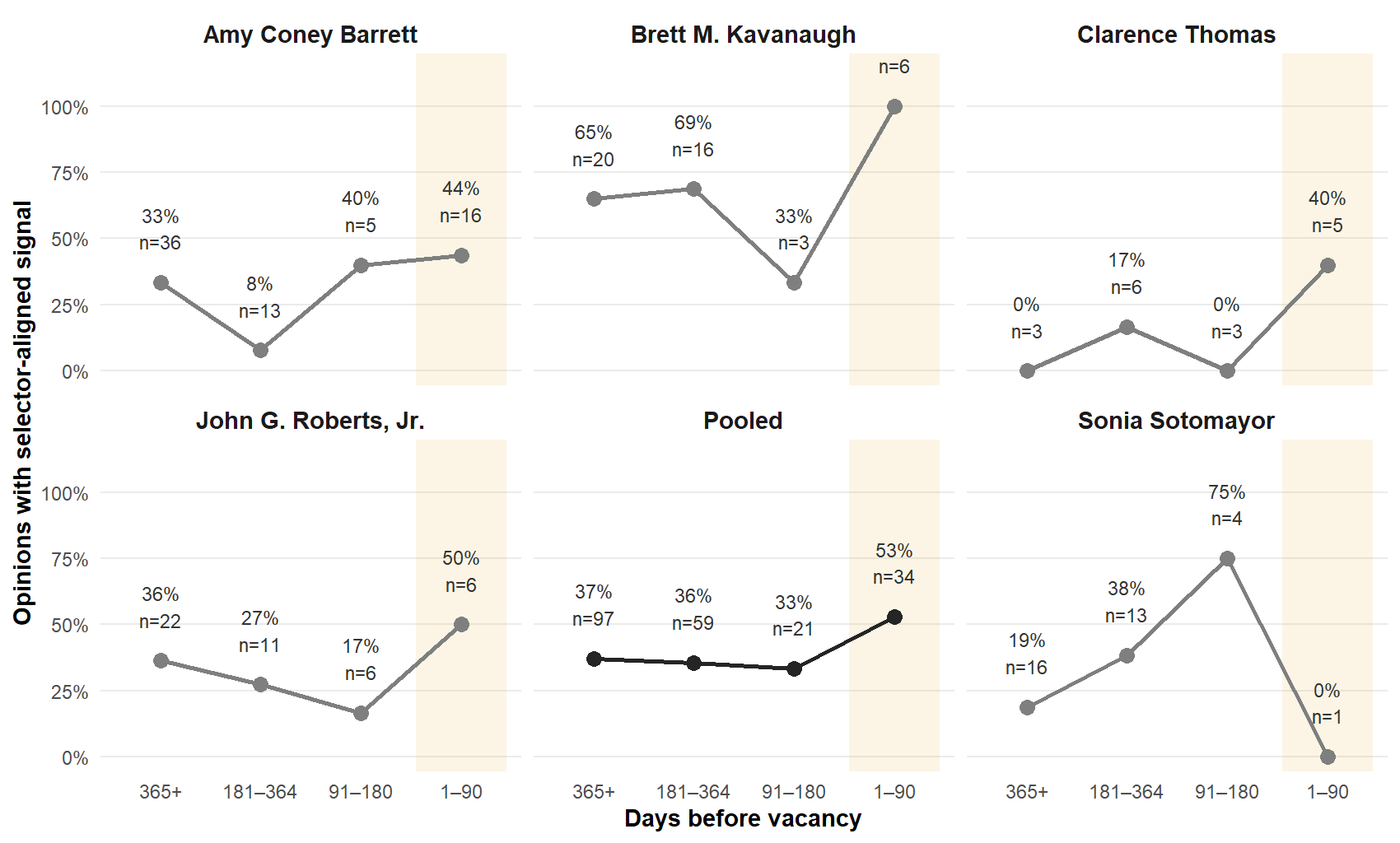
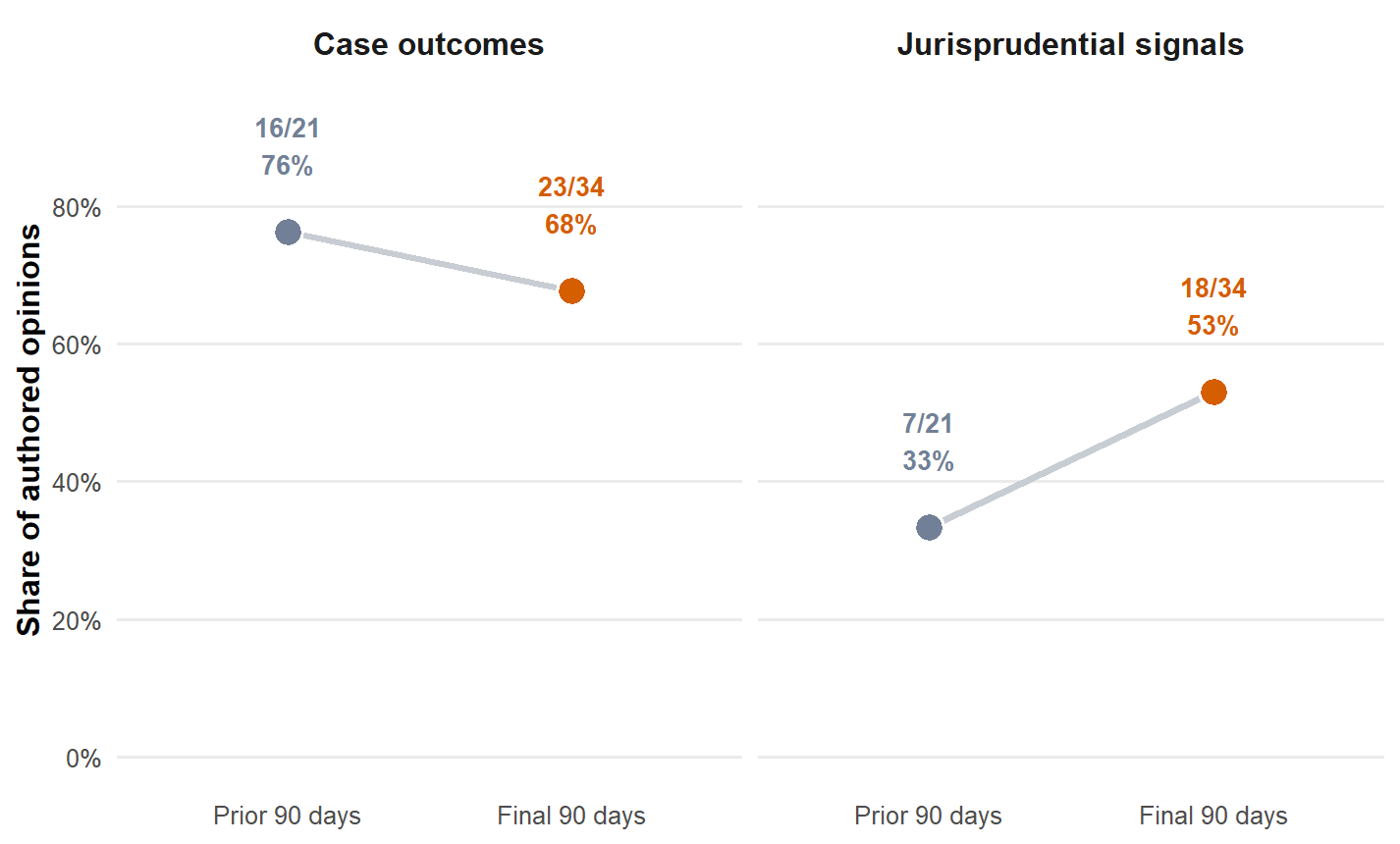
For this article I examined the pre-nomination writings of the current nine Supreme Court justices to see whether those signals changed as a potential vacancy approached. The clearest comparison uses five justices for whom the underlying opinion coverage is strongest: Thomas, Roberts, Sotomayor, Kavanaugh, and Barrett. Across those judges, 7 of 21 authored opinions in the period 91 to 180 days before the relevant vacancy contained a clear jurisprudential signal aligned with the political coalition that later selected the judge. In the final 90 days, the figure was 18 of 34.
The direction of the case results moved differently. Selector-aligned outcomes accounted for 16 of the 21 earlier opinions, or 76%. They accounted for 23 of 34 opinions, or 68%, during the final 90 days.
The distinction suggests a narrower form of judicial auditioning worth examining: greater visibility of jurisprudential commitments as a potential Supreme Court opening draws closer.
Measuring a Jurisprudential Signal
Any attempt to measure judicial auditioning runs immediately into a classification problem. A Republican president and a Democratic president are unlikely to value the same signals, and the ideological direction of a ruling depends on the legal issue involved. A decision favoring a criminal defendant, for example, carries different ideological implications from a decision favoring a religious-liberty claimant. Administrative-law cases create an additional complication because skepticism of an agency may point in different political directions depending on the regulation, the administration, and the reasoning employed.
Th coding of opinions was along separate dimensions. The first is the direction of the result: whether the disposition favored the position ordinarily associated with the political coalition that ultimately selected the judge. The coding rules depend on the issue. Greater protection for religious exercise or Second Amendment rights generally points in a Republican direction; broader voting access or greater protection for discrimination plaintiffs generally points in a Democratic direction. First Amendment cases are coded according to the particular dispute rather than a general party rule.
The second dimension is the expressive content of the opinion. Here the question is what the judge chose to communicate through the reasoning. The coding captures features such as an unusually clear commitment to textualism or originalism, structural limits on government power, deference to executive authority, skepticism of administrative agencies, expansive protection of an individual right, or another doctrinal position with an identifiable relationship to the selecting coalition. The strength of the signal is coded separately from its direction.
That separation allows an opinion’s result and its jurisprudential signal to point in different directions. Roberts’s concurrence in National Treasury Employees Union v. FLRA is an example. The union obtained a remand, a result coded in the union’s direction. Roberts’s separate reasoning emphasized management and security authority and preserved a route for the agency to reject the union’s proposal. The disposition and the additional signal therefore receive different codes.
The rules work in the other direction as well. Shortly before his Supreme Court nomination, Kavanaugh wrote separately in Ortiz-Diaz v. HUD Office of Inspector General to advocate greater protection for an employee pursuing a race-discrimination claim. Under the same issue-specific rules, that writing counts against alignment with a Republican selector. Barrett’s opinion denying qualified immunity to a detective in Rainsberger v. Benner likewise receives a plaintiff-protective code. A separate opinion receives no favorable treatment simply because the eventual nominee chose to write it.
The final dataset contains 273 authored opinions. Each opinion has a case-specific issue classification, outcome code, expressive-tenor code, signal-strength measure, coding rationale, and source. As a final check, the substantive coding rules were audited without the event-time variables that identify how close an opinion fell to a Supreme Court vacancy. All of the clear selector-aligned signals in the final 90-day period were then checked individually against the underlying opinions or primary case sources.
That coding provides the basis for comparing changes in judicial outcomes with changes in what eventual nominees chose to emphasize in their written work.
The Pattern in the Opinions
The comparison closest to the vacancy covers 55 opinions written by the five justices with the strongest underlying coverage. Twenty-one were issued between 91 and 180 days before the relevant vacancy. Thirty-four came during the final 90 days.
The change in jurisprudential signaling is fairly pronounced. Seven of the 21 opinions in the earlier period, 33%, contained a clear signal aligned with the political coalition that later selected the judge. During the final 90 days, 18 of 34 opinions, or 53%, did. The number of especially strong signals also increased, from two in the earlier period to seven in the final 90 days.
Case outcomes followed a different pattern. Sixteen of the 21 earlier decisions, 76%, produced results aligned with the eventual selector. During the final 90 days, 23 of 34 did so, or 68%. The judges therefore became somewhat less likely to reach a selector-aligned result during the same period in which their written reasoning became more likely to contain an aligned jurisprudential signal.
The difference between those measures is central to what the data capture. A judge can reach an unremarkable or even politically unfavorable result while using the opinion to articulate a position on statutory interpretation, executive authority, constitutional structure, individual rights, or another issue of interest to a future administration. A judge can also reach a politically favorable result through routine application of precedent without saying much about a broader judicial philosophy. Those are different observations in the coding.
The pattern also does not depend on treating every concurrence or dissent as a signal. Separate writings were coded according to their substance. Some moved toward the eventual selector, some moved away from it, and others carried no meaningful ideological signal. Majority opinions could qualify as well when their reasoning made a sufficiently clear jurisprudential commitment.
With samples this small, the percentages should be read descriptively. They nevertheless provide a useful answer to the first question posed by the data. The observable change near a vacancy appears more clearly in the reasoning judges put into the public record than in the ideological direction of the judgments they entered.
Roberts and the Spring of 2005
Roberts provides the clearest case for seeing how the distinction operates at the level of individual opinions. His D.C. Circuit record is unusually close to a complete authored-opinion universe. Contemporary materials submitted to the Senate identified 49 cases during his tenure in which Roberts wrote an opinion. The dataset accounts for 47 of those before Bush publicly selected him on July 19, 2005, and two more issued after his selection. Six of the 47 pre-selection writings came during the 90 days before O’Connor announced her retirement (his first nomination was for the associate position when O’Connor announced retirement and was only later changed to the nomination to Chief after Rehnquist passed).
Three of those six contain a clear selector-aligned signal under the coding rules. Their significance lies less in the number than in the relationship between the result and Roberts’s own contribution.
In National Treasury Employees Union v. FLRA, the court sent a dispute involving Customs Service employees back to the Federal Labor Relations Authority. Roberts joined that disposition, which favored the union’s effort to obtain further review. He wrote separately, however, to emphasize the agency’s ability to invoke its statutory authority over internal-security practices. His concurrence also explained why the FLRA could again reject the union proposal if it supplied an adequate explanation. The union-favorable disposition accordingly receives a different code from Roberts’s more management- and agency-protective separate reasoning.
The contrast was sharper in AFL-CIO v. Chao, decided on June 3. The case concerned Labor Department rules requiring unions to provide more detailed financial disclosures. Roberts agreed with portions of the court’s ruling but dissented from its decision to invalidate part of Secretary Elaine Chao’s rule. His separate opinion relied heavily on the statutory language and would have sustained more of the position taken by a cabinet official in the administration that was then considering candidates for the Supreme Court.
Other opinions from the same 90-day period keep the example from becoming too tidy. In Amoco Production Co. v. Watson, Roberts upheld the Interior Department’s interpretation of federal royalty requirements. The regulatory result does not fit a conventional deregulatory conservative outcome, although the opinion contains a discernible text- and structure-based approach to statutory interpretation. Outlaw v. Airtech Air Conditioning & Heating, Inc., a private commercial dispute decided a week before O’Connor’s announcement, offers little meaningful ideological content at all.
Roberts’s record during these months therefore contains several kinds of observations: aligned results, unaligned results, strong jurisprudential signals, and opinions with almost no usable political signal. The two separate writings are especially revealing because Roberts chose to add reasoning beyond what was necessary to join the court’s disposition. Both appeared during the final three months before the vacancy, and both made positions relevant to the Bush administration’s legal agenda more visible in his public record.
Six opinions cannot establish what Roberts intended. They do show why looking only at wins and losses would miss much of the potentially nomination-relevant information contained in an appellate judge’s work.
The Pattern Varies by Judge
The pooled numbers conceal substantial differences among the five judges (now justices).
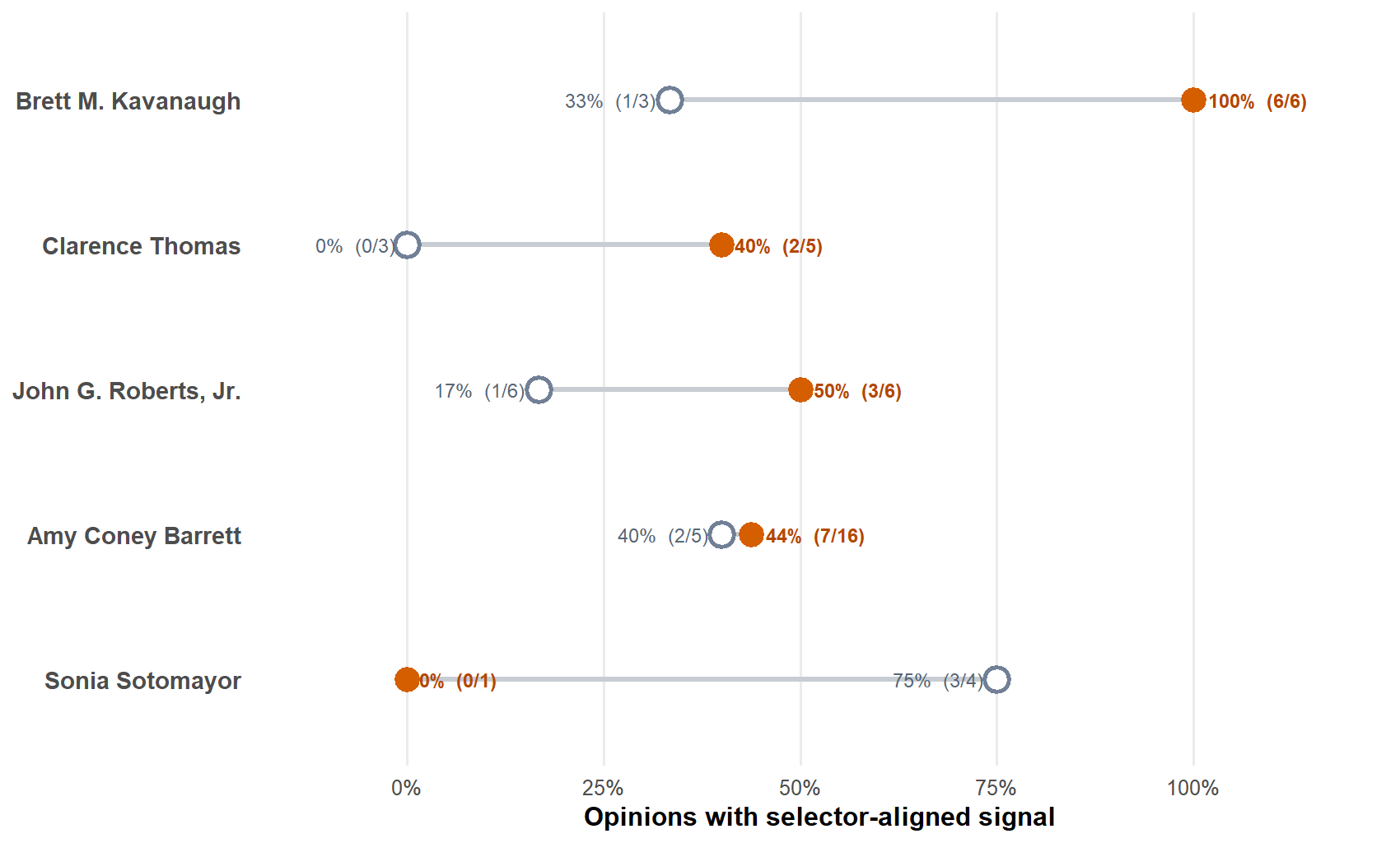
Kavanaugh shows the largest change. Only one of his three opinions from 91 to 180 days before the vacancy contained a clear selector-aligned jurisprudential signal. All six of his opinions in the final 90 days did. Roberts moved from one of six to three of six, while Thomas moved from none of three to two of five.
Barrett’s change was smaller. Two of her five opinions in the earlier period contained a clear aligned signal, compared with seven of 16 in the final 90 days. She also wrote considerably more opinions during the later period, making her record useful for seeing variation within the same window. Several opinions contained strong signals, while others pointed in the opposite political direction or carried little ideological content.
Sotomayor provides the clearest counterpoint. Three of her four opinions in the earlier period contained a signal aligned with a Democratic selector. Her final 90-day period contains only one authored opinion in the dataset, United States v. Abdulle, and that decision affirmed a drug-conspiracy conviction. It therefore runs against the Democratic-selector direction. With one observation, the final period says little about a change in Sotomayor’s behavior, but it prevents the pooled result from being read as a pattern that appears mechanically for every eventual nominee.
The differences also caution against treating the percentages as individual measures of ambition. Appellate judges do not control the cases assigned to their panels, and they have varying opportunities to write opinions that reveal broader commitments. The relevant pattern is whether those opportunities, taken together, produced a greater concentration of selector-aligned signals as the vacancy approached.
What the Signals Look Like Across Judges
Kavanaugh’s final months on the D.C. Circuit provide some of the clearest examples. In May 2018, he wrote for the court in Santa Fe Discount Cruise Parking v. Federal Maritime Commission, vacating an agency decision because the commission had failed to justify its differential treatment of parking operators. The coding treats the opinion as a visible agency-skeptical signal.
On June 15, less than two weeks before Justice Anthony Kennedy announced his retirement, Kavanaugh issued two dissents. In Island Architectural Woodwork v. NLRB, he rejected the National Labor Relations Board’s alter-ego determination and argued that the agency’s conclusion was unreasonable. In United States v. Brown, he objected to defendant-favorable sentencing rulings and defended broader judicial consideration of a defendant’s actual conduct at sentencing. Both are classified as particularly strong selector-aligned signals, although they arise in different areas of law.
Barrett’s final 90 days show a broader mix. Her concurrence in United States v. Wilson defended the constitutionality of stopping a fleeing suspect and received a strong aligned code. Her dissent in United States v. Uriarte, issued three days before the vacancy created by Justice Ruth Bader Ginsburg’s death, took a restrictive view of the First Step Act’s application to a defendant awaiting resentencing. Other opinions during the same period favored law enforcement, employers, or arbitration.
The same stretch also contains decisions that resist a simple political characterization. Barrett granted relief to an immigrant in Morales v. Barr and ordered a new trial for a pretrial detainee in Pittman v. Madison County. An opinion sustaining the IRS against a corporate taxpayer was coded against the expected Republican direction on the outcome and as neutral in its expressive signal. Those decisions remain part of the denominator.
Thomas’s record offers another version of the pattern. In Cross-Sound Ferry Services v. ICC, he wrote separately to argue that the challengers lacked Article III standing and that the court therefore lacked authority to reach the merits. Shortly afterward, in Citizens Against Burlington v. Busey, he rejected most of an environmental challenge to airport expansion while emphasizing the limited role of courts reviewing agency policy judgments. Neither signal depends simply on which litigant prevailed. The coding turns instead on the broader principles Thomas chose to emphasize: limits on judicial power in one case and judicial restraint in reviewing administrative decisionmaking in the other.
Across the judges, the content varies with the cases before them. The recurring feature is greater visibility of jurisprudential positions that would have been recognizable to the political and legal officials evaluating potential nominees.
Limits of the Evidence
The data cannot identify a judge’s motive for writing an opinion or choosing particular reasoning. Case assignment also constrains the opportunities available to any judge during a 90-day period, and the number of opinions for several justices is small. The analysis is limited to authored opinions, leaving silent votes outside the dataset.
The coding presents another source of judgment. Each opinion was classified under issue-specific rules, with the result separated from the content of the judge’s reasoning, and the final audit was conducted without the event-time variables. The classifications nevertheless require legal judgments about the direction and strength of particular signals. The findings are best understood as evidence of a pattern in the public records of eventual nominees, rather than evidence of what any judge privately intended.
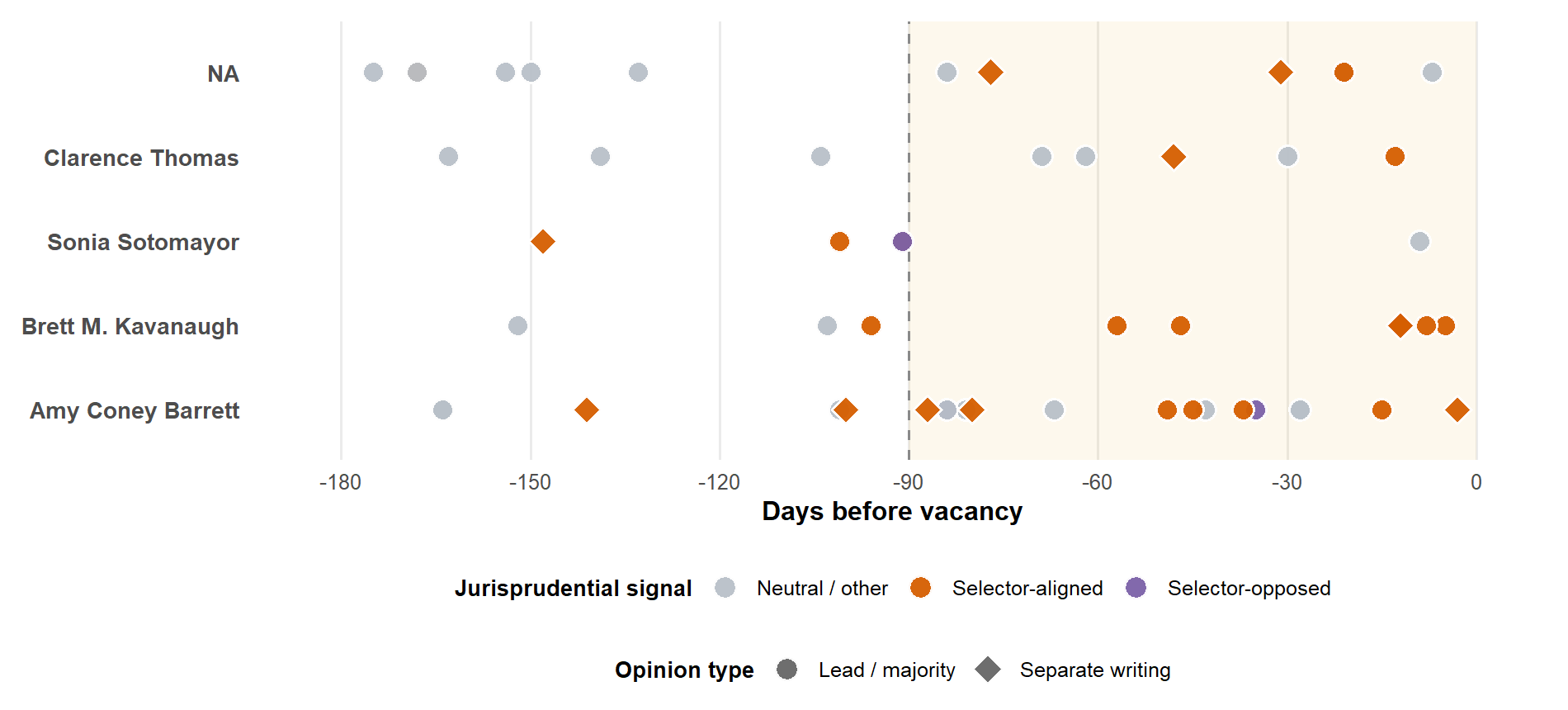
The figure above traces every authored opinion during the 180 days before the relevant vacancy. Each point represents one opinion. Color identifies selector-aligned, selector-opposed, or neutral expressive content; shape distinguishes lead/majority opinions from separate writings. A vertical line marks 90 days before the vacancy. Label a small number of the opinions discussed in the text.
What to Watch Before the Next Vacancy
The next useful test of the pattern can begin before anyone knows whether there will be a vacancy.
Supreme Court retirement speculation already produces intensive attention to the justices who might leave and to the lawyers who might replace them. Justice Samuel Alito has been the subject of such speculation recently, although reporting in April indicated that he planned to remain on the Court through at least 2026, and a June report announcing his retirement was quickly retracted. Similar speculation will eventually surround another justice, whether or not a retirement follows.
At that point, attention should extend beyond the names appearing on administration shortlists. The appellate judges most plausibly under consideration will continue deciding cases in public. Their opinions can be followed as they are issued.
Several features would be worth watching.
A concurrence or dissent deserves attention when a judge could simply have joined the disposition but instead uses a separate writing to address constitutional structure, executive power, administrative authority, religious liberty, the Second Amendment, statutory interpretation, or another issue important to the appointing coalition. Majority opinions can provide the same information when they adopt a particularly broad rule or make an interpretive commitment unusually explicit.
The comparison should also include opinions pointing the other way. An expected nominee who writes an expansive civil-rights opinion, rules against executive power, rejects a government immunity claim, or otherwise takes a position unattractive to the relevant administration provides useful evidence. The question is whether the balance of the judge’s written record changes, rather than whether individual opinions can be placed on a nomination narrative after the fact.
Timing should be recorded as well. An opinion issued a year before a possible vacancy carries different information for this inquiry than a voluntary concurrence issued while retirement rumors are circulating and a White House is assembling a shortlist.
That creates a straightforward opportunity the next time vacancy speculation becomes serious: identify the plausible appellate candidates, establish their prior written records, and follow their new opinions prospectively. If the pattern found here appears again, the signs may be visible before the nomination is.