

How Statistically Predictable Were 2025/2026 Term Supreme Court Argued Case Outcomes?
Oral arguments and ideology provide a bevy of formation about how the justices may vote. This article shows the success of these measures when leveraged to predict recent case outcomes.

Some Supreme Court arguments seem relatively easy to read. After the Court reheard Louisiana v. Callais, Fox News reported that the conservative majority appeared “poised to significantly weaken” the Voting Rights Act. Justices Clarence Thomas, Samuel Alito, and Neil Gorsuch had questioned the constitutionality of race-conscious redistricting, while Justice Brett Kavanaugh suggested that such remedies might require a time limit. The eventual decision confirmed the broad direction visible from the bench, even if the scope and doctrinal structure of the ruling were harder to foresee.
Other arguments reveal the likely winner more clearly than the precise coalition. In Trump v. Barbara, CBS News reported that the Court appeared skeptical of President Trump’s effort to restrict birthright citizenship, while a preargument Washington Post analysis described the administration’s chances of prevailing as extremely low. The administration ultimately lost. But the exact lineup was less apparent: Chief Justice John Roberts wrote the Court’s opinion, and the judgment drew support from members of both ideological blocs.
Chatrie v. United States illustrates the opposite problem. After argument, the Associated Press reported that the Court seemed inclined to permit police use of geofence warrants and that the justices had not embraced Okello Chatrie’s Fourth Amendment challenge. The Court later ruled 6–3 that the government’s acquisition of his cellphone-location records was a search. One postdecision account called the result “somewhat surprising” because the argument had appeared to point toward continued use of the warrants, perhaps subject only to limits on time and geographic scope.
Together, the three cases capture the promise and the danger of reading the Court from the bench. Sometimes the questioning exposes the likely direction of the decision. Sometimes it identifies the winner but not the coalition. And sometimes a confident reading of the argument points the wrong way.
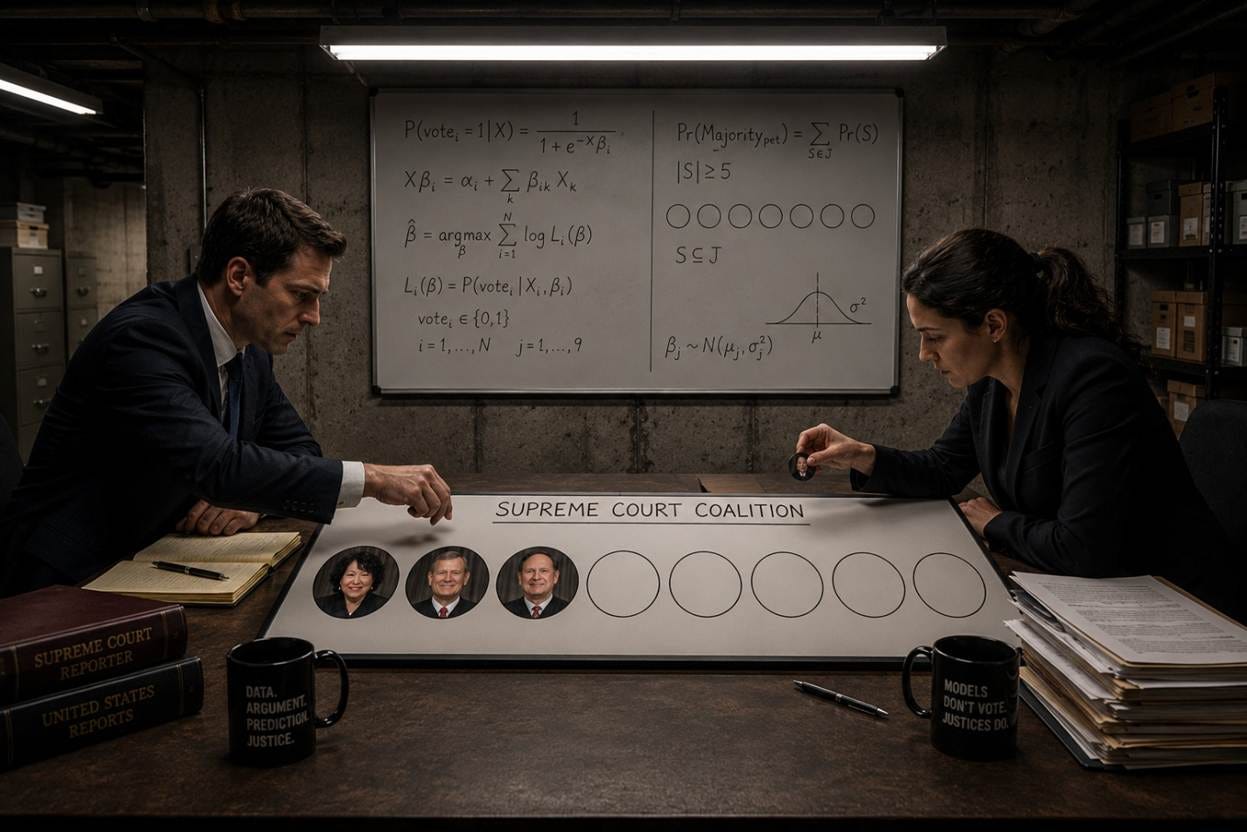
This article tests whether the apparent signals can be measured systematically. It examines the 56 signed decisions in cases argued from October 2025 through April 2026, encompassing 495 individual justice votes. The analysis compares several ways of reading oral argument: the number of words and speaking turns directed to each side, proportional and justice-specific measures of questioning, Court-wide patterns, and the question-based measures used in earlier empirical research. It then compares those measures with Martin–Quinn ideological scores, models combining ideology and oral argument, and simple rules such as always selecting the petitioner (historically the Court rules for petitioners 66% of the time or more. One theory for this is that the justices have more to gain by overturning lower court decisions than by upholding them).
The distinction between predicting votes and predicting winners is central. An oral-argument model may correctly identify most of the individual votes in a case and still miss the outcome if its errors include the pivotal members of the majority. Conversely, a rule that predicts the petitioner in every case may identify many winners without explaining much about the justices’ behavior.