


In 1989, Antonin Scalia joined the Supreme Court decision protecting the burning of the American flag. Texas v. Johnson made him part of a five-justice majority that included Brennan, Marshall, Blackmun, and Kennedy. He wrote no separate opinion. The vote nonetheless matters because it captures an aspect of Scalia that the standard political portrait can miss: when he thought the First Amendment’s rule protected conduct that many conservatives deplored, he joined the rule.
The following Term supplied a different kind of surprise. In Employment Division v. Smith, Scalia wrote the opinion rejecting constitutionally required religious exemptions from neutral, generally applicable laws. Religious-liberty advocates on the right have spent much of the subsequent generation seeking ways around Smith. Scalia’s reasoning rested on the language and existing Free Exercise doctrine, as well as the difficulty of a case-by-case compelling-interest test. The decision reflects a familiar Scalia instinct: a preference for a rule that limited judicial balancing.
Those cases are a good place to start because they make the larger question concrete. Scalia changed the Court’s vocabulary of constitutional interpretation, and he often pushed its results to the right. His judicial commitments also had consequences that did not reliably track contemporary political preference. The question is how often and in what settings those commitments—not just outcomes—defined his opinions.
The answer here comes from a structured reading of 108 signed Scalia opinions: an even mix from his early, middle, and late Supreme Court years, across majorities, concurrences, and dissents. The pattern is less a story of conversion than of a durable toolkit. Text, precedent, categorical rules, and resistance to balancing appear throughout. Original-public-meaning analysis becomes more explicit over time, especially in criminal procedure.
The method was visible before SCOTUS
Scalia’s D.C. Circuit years offer a short prologue. Its administrative and statutory docket should not be pooled with the Supreme Court constitutional data. Yet several opinions already show familiar habits: close attention to enacted language, skepticism toward judicial supplementation of a statutory scheme, and a preference for rule-bound resolution over open-ended balancing. In National Coalition to Ban Handguns v. BATF, Scalia treated statutory text as controlling despite inconclusive legislative history. In In re Reporters Committee for Freedom of the Press, he treated historical practice as a constraint on constitutional expansion.
Those opinions do not establish that the Supreme Court justice was fully formed before 1986. They do establish that the later pattern did not arrive suddenly with a new title or a new set of colleagues.
As the Court changed, Scalia’s place changed too
Scalia’s ideological location changed markedly over time, at least on the Martin–Quinn estimates. His score rose from 1.39 in 1986 to 3.54 in 1999 and remained near that level in 2000. It later declined, reaching 1.59 in 2015. For nearly all of 1987 through 2011, he ranked second from the Court’s ideological right. After Alito’s arrival, he ranked third from the right alongside Thomas and Alito.
That trajectory matters, though it should not be mistaken for a measure of originalism. It describes voting location relative to an evolving Court. Scalia’s position became more distinctive during the 1990s and less distinctive in the Roberts years partly because the Court acquired justices who were estimated to his right. A justice’s numerical location can shift even if the underlying commitments in his opinions remain relatively stable.
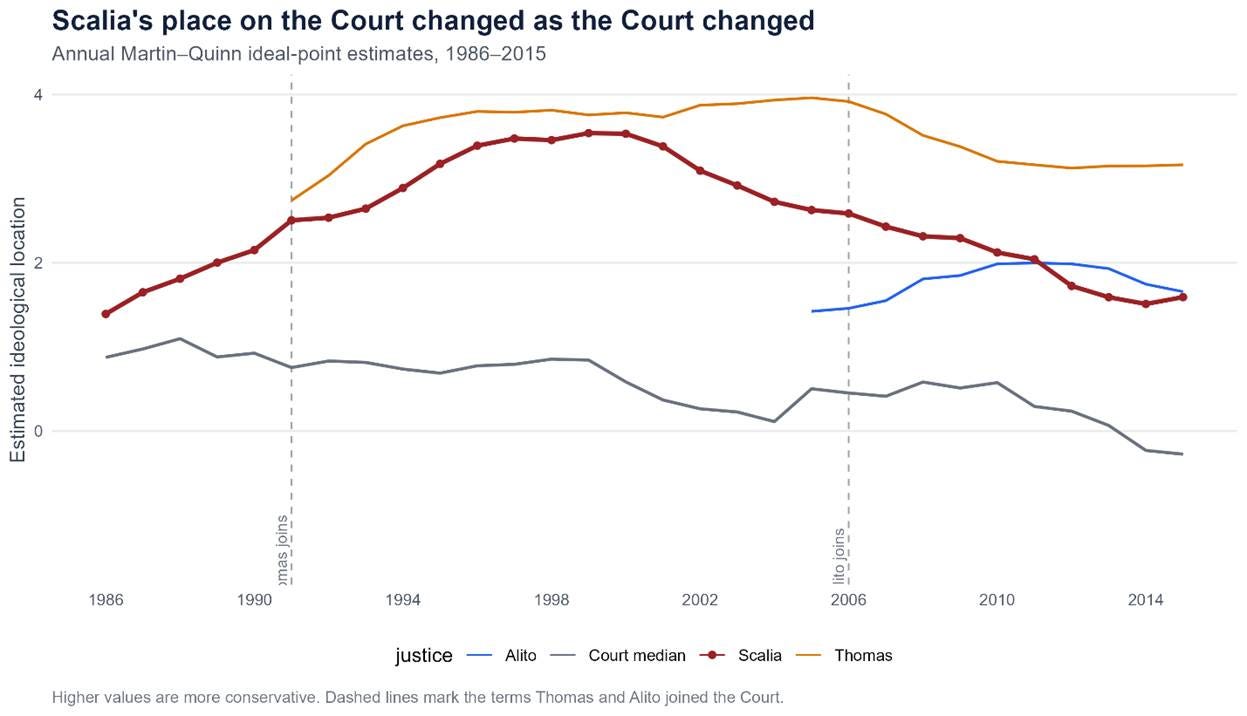
The graph above has annual Martin–Quinn estimates for Scalia, the Court median, Thomas, and Alito. Vertical reference lines mark the terms in which Thomas and Alito joined the Court.
The coalition data tell a related story. In constitutional cases, Scalia’s agreement with Rehnquist averaged 86 percent in the early period and 81 percent in the middle period. His agreement with Thomas was 91 percent early, 95 percent in the middle period, and 89 percent late. Agreement with Kennedy fell from 83 percent early to 72 percent late. Roberts and Alito became his closest regular partners in the final period after Thomas. The relevant change was partly one of relationships: the Court’s center and its conservative bloc were reorganized around him.
That institutional story helps put familiar labels in perspective. The raw number of constitutional opinions Scalia authored also fell over time—from 136 in the first nine Terms to 103 in the next ten and 85 in the final eleven—but the share of constitutional cases in which he wrote remained near 40 percent after the early period. The more telling shift was where his distinct voice sat within the Court. By the Roberts years, Scalia was still a powerful author and dissenter, though he was no longer the most conservative member of the Court’s conservative wing.
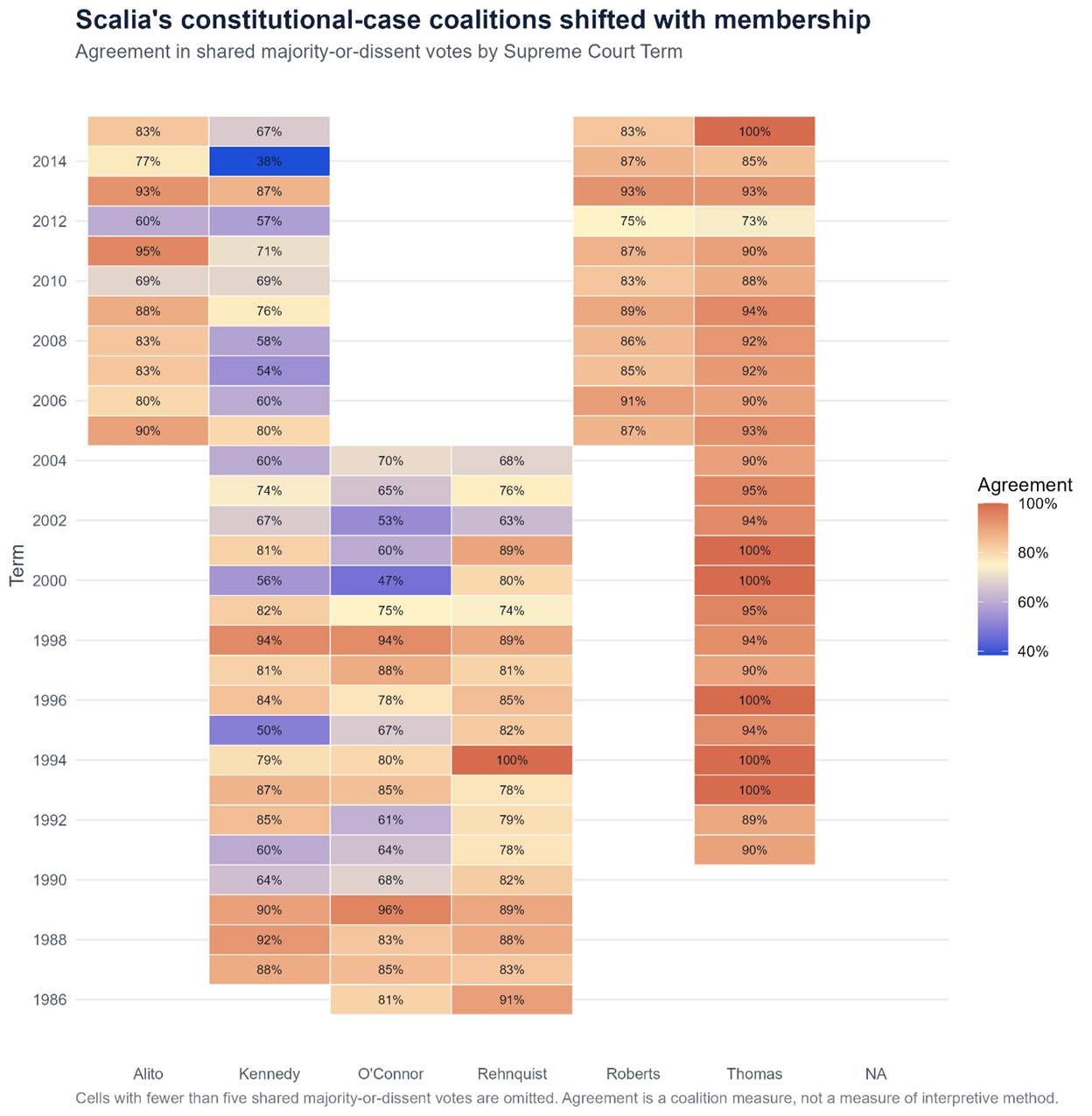
Term-by-term agreement rates in shared constitutional cases, displayed as a heat map above. The figure records voting coalitions, not interpretive method or ideology.
Originalism had company
In terms of coding, references to “original meaning,” “ratification,” “the Framers,” “history,” “tradition,” “text,” “balancing,” and “stare decisis” identified passages for review; the score reflected whether the opinion treated that source of authority as peripheral, material, or decisive. Heller, for example, received a high original-public-meaning score because its analysis turned on what the Second Amendment’s text conveyed when adopted. A loose reference to “the Framers” did not establish original intent; that score required the opinion to rely on what particular Framers or ratifiers intended or expected.
The opinion sample makes the central distinction clearer. Original-public-meaning reasoning was central—meaning a material premise or principal justification—in 19 percent of the early-period opinions, 31 percent of the middle-period opinions, and 39 percent of the late-period opinions. Framing-era history followed a similar path, rising from 17 percent to 33 percent and then remaining at 33 percent.
Those increases are meaningful, but they are only part of the picture. Ordinary constitutional text was central in 72 percent of the early sample, 97 percent of the middle sample, and every late-period opinion. Precedent was central in 97 percent, 100 percent, and 89 percent, respectively. Rule-like or anti-balancing reasoning was central in all but three of the 108 opinions.
Precedent, in particular, played a more complicated role than the popular image of Scalia the overrule-er suggests. In 47 of the 108 opinions, he followed precedent; in another 40, he criticized a precedent but applied it. He urged overruling in 16. The proportions changed somewhat over time, with more late opinions pressing against precedent, yet the recurring picture is of a justice who treated precedent as an object of argument rather than simply an obstacle to be cleared.
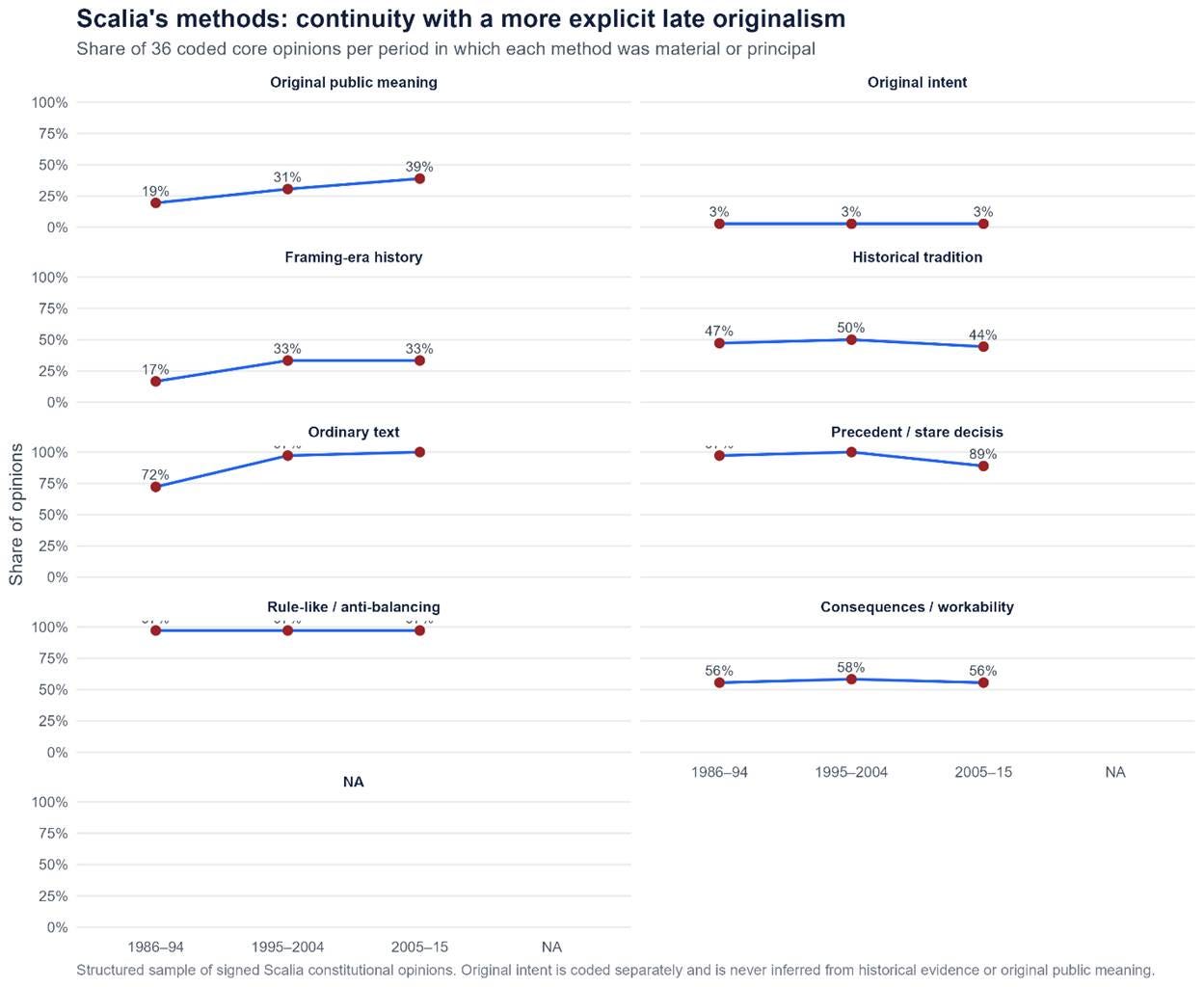
Each panel above reports the share of the 36 coded core opinions in a period in which the method was material or principal. All panels use the same 0–100 percent scale.
The contrast is especially helpful in reading Employment Division v. Smith. The 1990 opinion is often presented as an awkward fit with the originalist label because it curtailed constitutionally required exemptions from generally applicable laws. Its reasoning, however, fits a recurring Scalia pattern. Smith relied heavily on text and precedent and rejected the compelling-interest balancing framework as unadministrable. Historical inquiry was peripheral. That was an instance in which a different part of Scalia’s methodology did the decisive work.
That pattern could run in either direction. In Burnham v. Superior Court, Scalia used historical practice to defend a traditional rule of personal jurisdiction. In Harmelin v. Michigan, his opinion treated the Eighth Amendment’s original understanding as a reason to reject proportionality review. Both are recognizably originalist opinions, yet each also sought a rule that would constrain judge-by-judge judgment. The combination—history joined to rule-making—became especially visible in his later criminal-procedure work.
Crawford v. Washington and District of Columbia v. Heller illustrate the later, more visible originalist side of the record. In Crawford, founding-era materials reconstructed the Confrontation Clause and supported a categorical rule for testimonial statements. In Heller, text, founding-era sources, structure, and historical practice combined to define the Second Amendment’s scope. These are essential cases, though they should not be treated as an average Scalia opinion. Their significance lies partly in showing how historical analysis could build firm doctrine rather than simply decorate a result.
The original-intent audit sharpens the point further. Original intent was coded separately from original public meaning and from the use of founding-era history. It appeared at any level in 19 percent of early opinions, 14 percent of middle-period opinions, and 17 percent of late opinions. It was material in only one opinion per period and never the principal justification. The evidence supports a description of Scalia as an original-public-meaning originalist far more readily than as an original-intent originalist. Lee v. Weisman, McCreary County v. ACLU, and NLRB v. Noel Canning are the material-intent examples; they do not form an ascending career-wide trend.
That distinction is worth keeping because it avoids treating every reference to the Founding as the same claim. Heller asked what the Second Amendment’s words conveyed when adopted. Crawford reconstructed the confrontation right through the common-law materials that informed the constitutional text. In the three cases where original intent was material, Scalia placed more weight on what the founding generation expected the relevant constitutional provision to accomplish. The data show a substantial historical method; they do not show a career built principally on recovering the subjective intentions of individual Framers.
Where history did the most work
The rise in original-public-meaning reasoning is not evenly distributed. It is clearest in criminal procedure. In the coded criminal-procedure opinions, the share with original-public-meaning analysis central rose from four of ten early opinions to six of nine middle-period opinions and seven of eleven late-period opinions. The comparable First Amendment counts are one of ten, three of twelve, and two of eight. That distinction counsels against describing every late Scalia opinion as more originalist than every early one.
The speech comparison also returns the article to Texas v. Johnson. Scalia’s vote there was doctrinally conventional in one sense: the majority treated flag burning as expressive conduct protected against a state’s effort to punish its message. The larger significance lies in the absence of a matching historical surge in his First Amendment opinions. The late-career increase in original-public-meaning reasoning was concentrated in settings where historical materials could define a constitutional rule with unusual precision, especially the Fourth, Fifth, and Sixth Amendments.
The criminal-procedure line also helps explain why the later opinions were so influential. Apprendi, Ring, Crawford, Giles, Melendez-Diaz, Jones, and Jardines used historical materials to replace standards with rules. In those fields, history gave Scalia a way to resist balancing tests and doctrinal multi-factor inquiries that he had criticized throughout his career.
Some leading cases resist simple categorization. Texas v. Johnson remains a vote-level counterpoint rather than an authored-opinion data point because Scalia wrote no separate opinion. Smith supplies the corresponding view from inside the opinion itself: its rejection of balancing is visible in the reasoning, rather than inferred from its result. A related administrative-law example lies outside this article’s constitutional dataset. Scalia joined Chevron and later wrote the majority opinion in City of Arlington v. FCC, applying Chevron deference over a dissent by Chief Justice Roberts, Kennedy, and Alito. That line shows the same willingness to accept an institutional allocation of interpretive authority even when later conservative legal politics turned against it. Boumediene v. Bush, NFIB v. Sebelius, and Obergefell v. Hodges reveal other pressures—precedent, institutional design, and practical consequences—that can be obscured by a single-word label.
The legacy: a key architecture and a changing influence
The empirical record supports an account of continuity with meaningful development. Scalia did not simply become more conservative and therefore more originalist. His Martin–Quinn score peaked in the middle of his career, while original-public-meaning reasoning was most frequent in the late sample. His place on the Court and his method thus followed different trajectories.
His durable contribution was to make a cluster of interpretive commitments more available and more consequential: constitutional text, historically grounded meaning, precedent pressed or challenged, and rules that narrowed the domain of judicial balancing. The flag-burning vote, Smith, and the Chevron line make the point vivid because each imposed a cost on an overly simple ideological account. Over time, original public meaning became more explicit and especially powerful in particular doctrinal settings. That evolution helps explain why Scalia remains a turning point in the Supreme Court’s history even when his opinions do not fit a single label.