


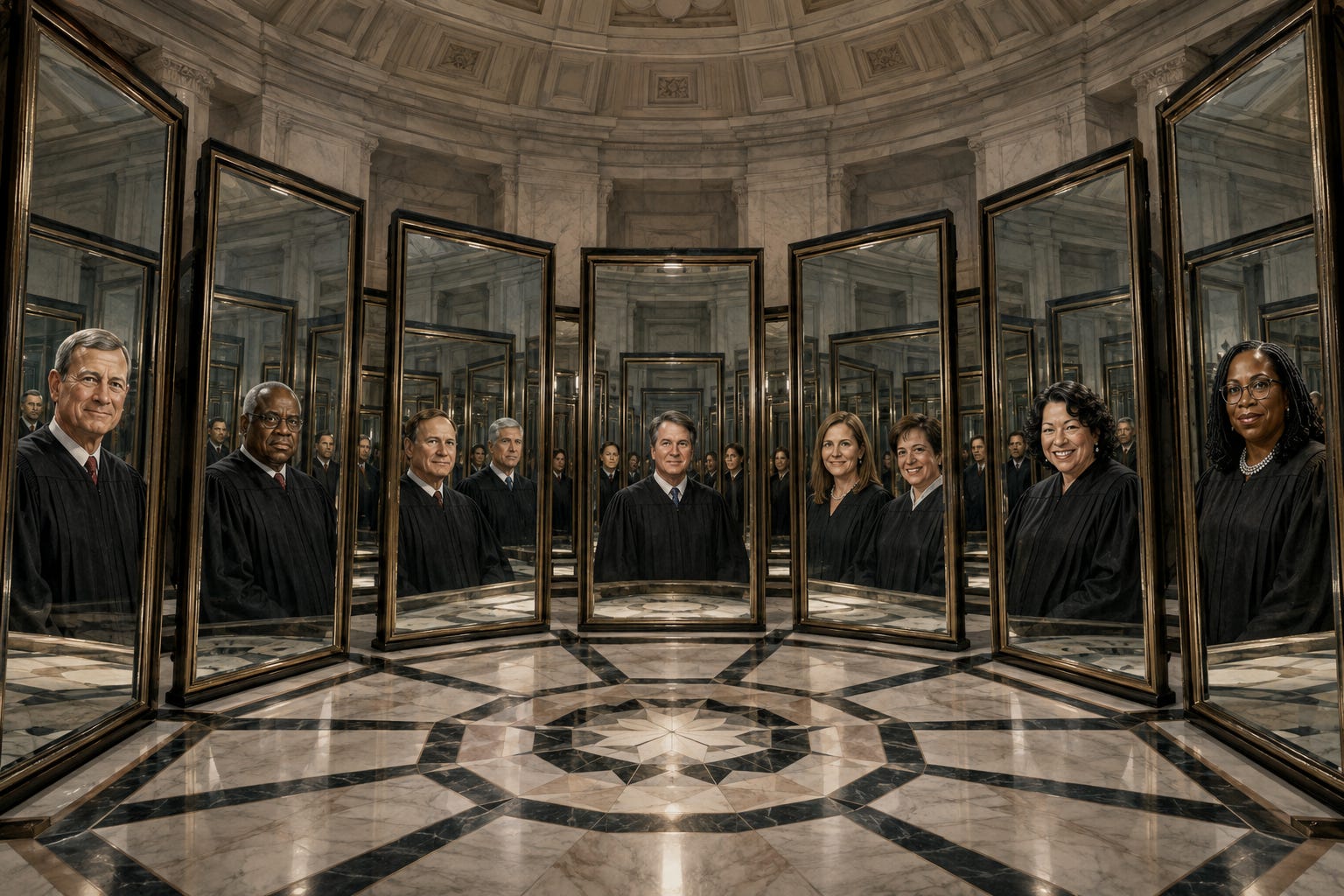
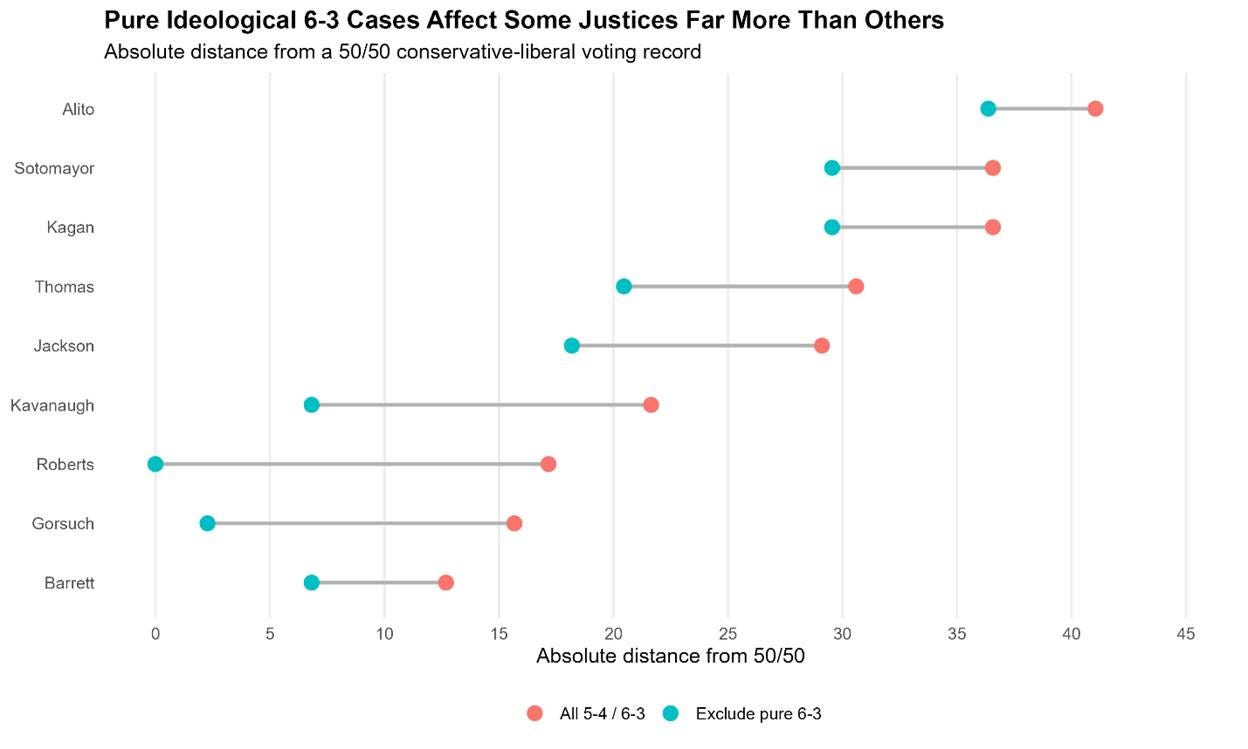
Chief Justice Roberts looks fairly conservative if we examine only the Supreme Court’s closest merits decisions. In cases decided 5-4 or 6-3 over the past four terms, 67.2% of his coded votes fell on the conservative side. That puts him 17.2% from an even 50/50 record—far more conservative looking than he appeared across the Court’s merits docket as a whole.
But take one category of cases out of the calculation and Roberts’s record changes dramatically. Remove the 6-3 decisions in which all six Republican-appointed justices voted in the conservative-coded direction and all three Democratic-appointed justices voted in the liberal-coded direction, and Roberts has 22 conservative votes and 22 liberal votes. Exactly 50/50.
Roberts is the cleanest example, but he is not the only justice whose ideological profile changes. Justices Gorsuch, Kavanaugh, and Barrett also move sharply toward the middle once the conventional ideological 6-3 cases are removed. Justices Alito and Thomas remain much farther to the conservative side. On the other end of the Court, Justices Sotomayor, Kagan, and Jackson remain substantially liberal-coded.
That creates an opportunity to look at the Court’s ideology from a different angle.
An earlier analysis of all merits decisions found a Court with clear ideological poles but also a group of Republican-appointed justices much closer to an evenly divided voting record. Roberts was only 3.4% from 50/50. Barrett was 2.5% away, Kavanaugh 5.1%, and Gorsuch 6.2%. Alito and Thomas were considerably farther to the conservative side, while Sotomayor, Jackson, and Kagan were considerably farther to the liberal side.
Those numbers included everything from unanimous decisions to the Court’s most contentious cases. But the decisions that tend to define public perceptions of the Supreme Court are the close ones. A 5-4 ruling can determine the scope of a constitutional right. A 6-3 ruling can produce headlines about the Court’s conservative supermajority. Looking only at those cases therefore provides a useful test: does the ideological structure seen across the full merits docket become substantially different when the analysis is restricted to the Court’s closest divisions?
The answer is yes—but with an important qualification. The closely divided docket makes almost every justice look more ideological. Much of that change, however, is driven by a particular subset of 6-3 decisions. Once those cases are separated from the rest, the Court’s middle reappears.
Three Ways to Look at the Same Court
The analysis uses the same basic measure as the earlier study. Each justice’s votes are coded as producing either a conservative or liberal outcome, following the Supreme Court Database approach and its extension to the most recent term. A justice voting conservative 50% of the time has a score of zero. A justice voting conservative 70% of the time is 20 points to the conservative side; a justice voting conservative 30% of the time is 20 points to the liberal side. Absolute distance from 50/50 provides a way to compare the strength of that tendency without treating movement to the left or right as inherently greater.
The new analysis compares three versions of the merits docket.
The first is the full set used in the earlier article. The second includes only merits cases decided by 5-4 or 6-3 votes. There are 67 such cases: 21 decided 5-4 and 46 decided 6-3.
The third removes the pure ideological 6-3 cases. These are cases in which the six Republican-appointed justices all voted in the conservative-coded direction and the three Democratic-appointed justices all voted in the liberal-coded direction. There are 23 such cases—exactly half of the 46 6-3 decisions in the sample and slightly more than one-third of all of the closely divided cases. Removing them leaves 44 merits decisions.
The distinction is important here because two cases can both end 6-3 while conveying very different information about the Court. One type produces the lineup now associated most closely with the Court’s ideological composition: Roberts, Thomas, Alito, Gorsuch, Kavanaugh, and Barrett on one side and Sotomayor, Kagan, and Jackson on the other. The other type produces a cross-ideological coalition. In several cases, for example, Roberts, Kavanaugh, and Barrett joined the three Democratic-appointed justices against Thomas, Alito, and Gorsuch. Both results appear in the U.S. Reports as 6-3 decisions. Only one represents a straight division between the Court’s Republican and Democratic appointees.
Separating those categories produces one of the clearest results in the data. Roberts, Gorsuch, Kavanaugh, and Barrett averaged about 4.3 points from 50/50 across the full merits docket. Restrict the analysis to 5-4 and 6-3 decisions and their average distance rises to 16.8 points. Remove the pure ideological 6-3 cases, however, and their average falls back to approximately 4.0 points.
For those four justices, in other words, the closely divided docket initially makes the Court’s middle look almost four times as ideological as it does across merits cases generally. Once the straight partisan-appointee 6-3 cases are removed, that difference almost entirely disappears. The Court’s ideological poles do not behave the same way.
Close Cases Push the Justices Toward the Poles
The first comparison shows why focusing only on closely divided cases can change the picture of the Court. Across all merits cases in the earlier analysis, the average justice sat about 10.5% from an even 50/50 conservative-liberal voting record. Among only the 5-4 and 6-3 cases, that average distance rises to 26.8%.
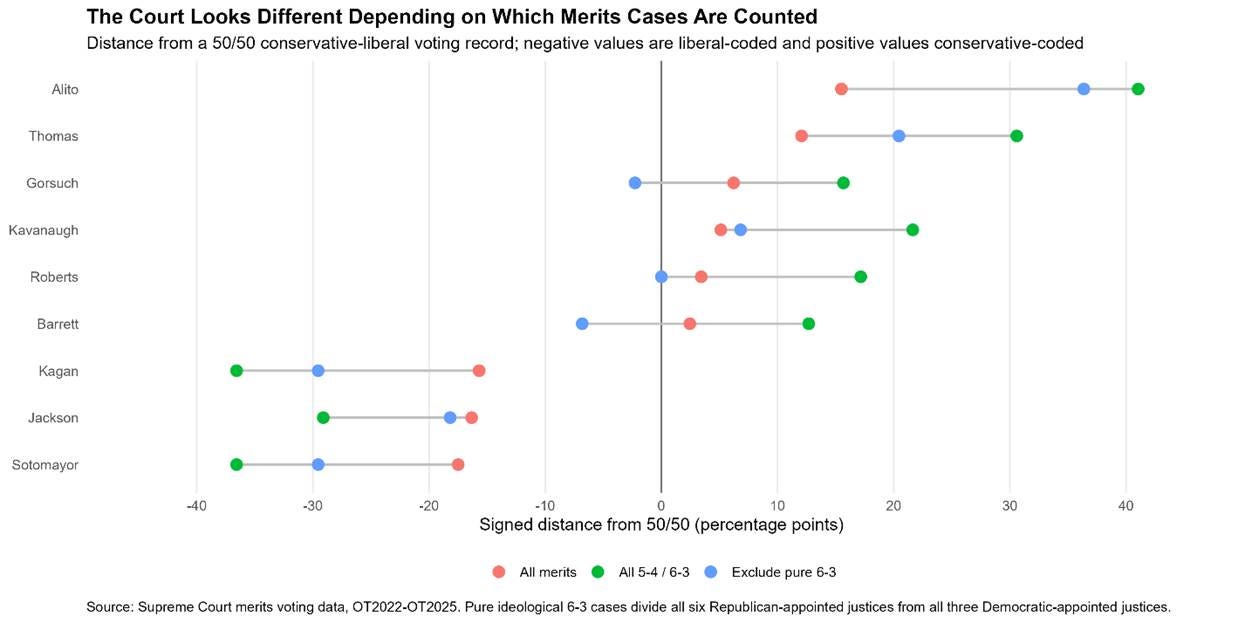
The change occurs across nearly the entire Court. Alito, for example, was 15.5 points to the conservative side across all merits cases. Among the closely divided cases, he is 41.0 points to the conservative side. Thomas moves from 12.1 points conservative to 30.6.
The same thing happens in the other direction. Sotomayor moves from 17.5 points to the liberal side across the full merits docket to 36.6 points among the 5-4 and 6-3 cases. Kagan moves from 15.7 points liberal to 36.6. Jackson moves from 16.3 to 29.1. The earlier merits analysis placed those justices, along with Alito and Thomas, among the justices farthest from the 50/50 line.
But the effect is not confined to the Court’s ideological poles. Kavanaugh goes from only 5.1 points to the conservative side across all merits cases to 21.6 points in the closely divided cases. Roberts moves from 3.4 to 17.2. Gorsuch goes from 6.2 to 15.7, while Barrett moves from 2.5 to 12.7.
There is nothing especially mysterious about part of this result. Selecting cases because they were decided 5-4 or 6-3 deliberately removes the many decisions in which most or all of the justices agreed. It leaves behind the cases in which disagreement was greatest.
But that alone does not explain the pattern. If closely divided cases simply magnified each justice’s ordinary voting tendencies, we would expect the same basic ideological map, only stretched farther away from the middle. Instead, something more interesting happens when one particular type of closely divided case is removed.
The conventional ideological 6-3 decisions account for much of the apparent movement of the Court’s middle—but much less of the movement at its poles.
Remove the Pure 6-3 Cases, and the Middle Comes Back
Of the 46 merits cases decided 6-3 in the dataset, 23 divide along the Court’s familiar appointment lines: all six Republican-appointed justices vote for the conservative-coded outcome, while all three Democratic-appointed justices vote for the liberal-coded outcome.
Those 23 decisions are only about one-third of the 67 closely divided cases in the analysis. But their effect on the ideological scores is substantial.
Across all nine justices, the average absolute distance from a 50/50 record is 26.8 points when every 5-4 and 6-3 case is included. Remove the pure ideological 6-3 cases and that falls to 16.7 points, a reduction of roughly 38%.
The decline is not evenly distributed. Roberts changes the most. His 67 closely divided votes initially divide 45 conservative to 22 liberal, putting him 17.2 points to the conservative side. Once the 23 pure ideological 6-3 cases are removed, his remaining votes divide 22 to 22.
Kavanaugh moves from 21.6 points conservative to 6.8 points conservative. Gorsuch goes from 15.7 points conservative to just 2.3 points on the liberal side. Barrett moves from 12.7 points conservative to 6.8 points liberal.
Those last two results are not evidence that Gorsuch or Barrett are liberal justices. They show something narrower: among closely divided cases that do not produce the standard 6-3 ideological lineup, their conservative- and liberal-coded votes are sufficiently balanced that both wind up slightly on the liberal side of the 50/50 line.
Taken together, the change for these four justices is striking. Across the entire merits docket, Roberts, Gorsuch, Kavanaugh, and Barrett averaged about 4.3 points from 50-50. Restrict the sample to all 5-4 and 6-3 cases and their average distance jumps to 16.8 points. Remove the pure ideological 6-3 cases, however, and their average falls to approximately 4.0 points.
In other words, the Court’s center-right quartet looks nearly four times as far from an evenly divided voting record when all closely divided cases are examined. But virtually that entire difference disappears once the straight ideological 6-3 cases are taken out.
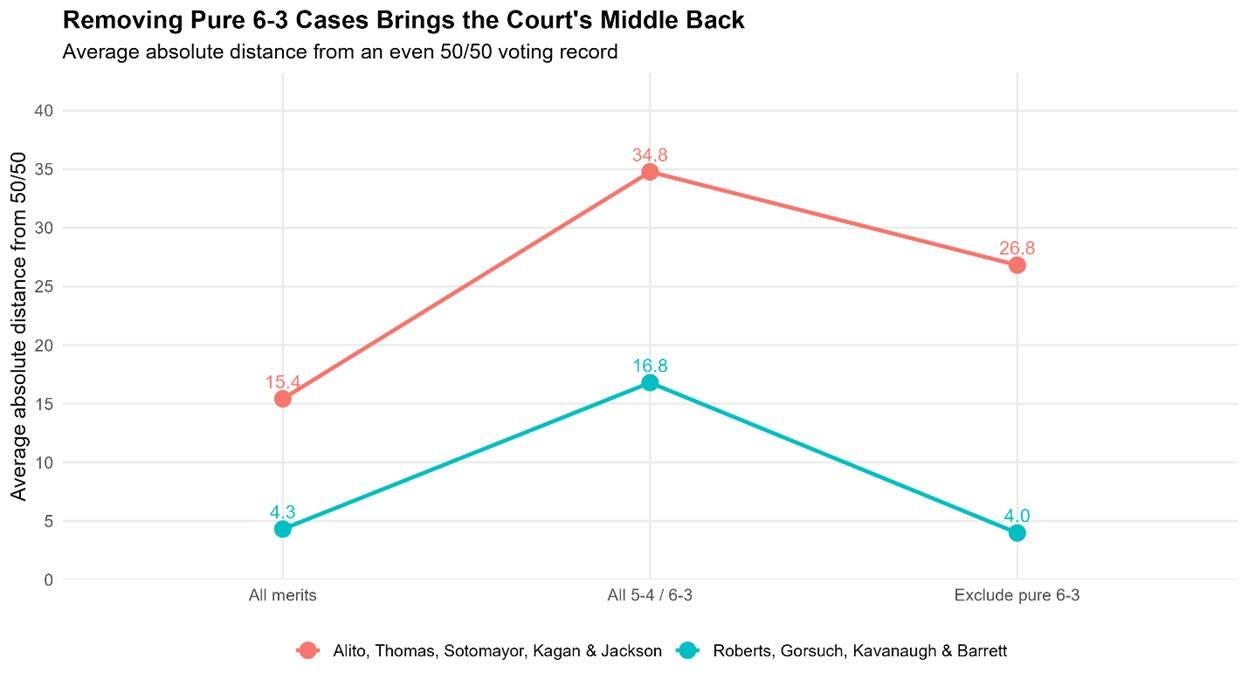
The second half of that graph is just as important as the first. Alito, Thomas, Sotomayor, Kagan, and Jackson averaged approximately 15.4 points from 50/50 across all merits cases. Among all 5-4 and 6-3 cases, their average rises to about 34.8 points. Removing the pure 6-3 decisions reduces it, but only to about 26.8 points.
Alito remains particularly distant from the middle. His score falls from 41.0 points conservative among all close cases to 36.4 after the pure 6-3s are removed. Sotomayor and Kagan each fall from 36.6 points liberal to 29.5. Thomas falls from 30.6 conservative to 20.5, while Jackson moves from 29.1 liberal to 18.2.
So removing the conventional 6-3 decisions changes both sides of the Court. But it does not change them equally.
For Roberts, Gorsuch, Kavanaugh, and Barrett, the resulting ideological distances closely resemble what we saw across the full merits docket. For the other five justices, the closely divided cases continue to produce much stronger directional voting even after the obvious ideological 6-3 decisions disappear.
That distinction sharpens one of the findings from the earlier analysis. The first article described Roberts, Barrett, Gorsuch, and Kavanaugh as substantially closer to the middle than Thomas and Alito, while the three Democratic appointees were farther to the liberal side. The close-case analysis suggests that this pattern was not simply being produced by unanimous and lopsided decisions.
Even in the Court’s most closely divided cases, a similar middle reemerges once the cases in which ideology perfectly predicts all nine votes are set aside. The next question is what those remaining cases actually look like.
The Remaining Cases Are Not Random Noise
Removing the pure ideological 6-3 cases does not leave a collection of unpredictable one-off coalitions. Some alternative alignments recur often enough to help explain why the ideological scores move.
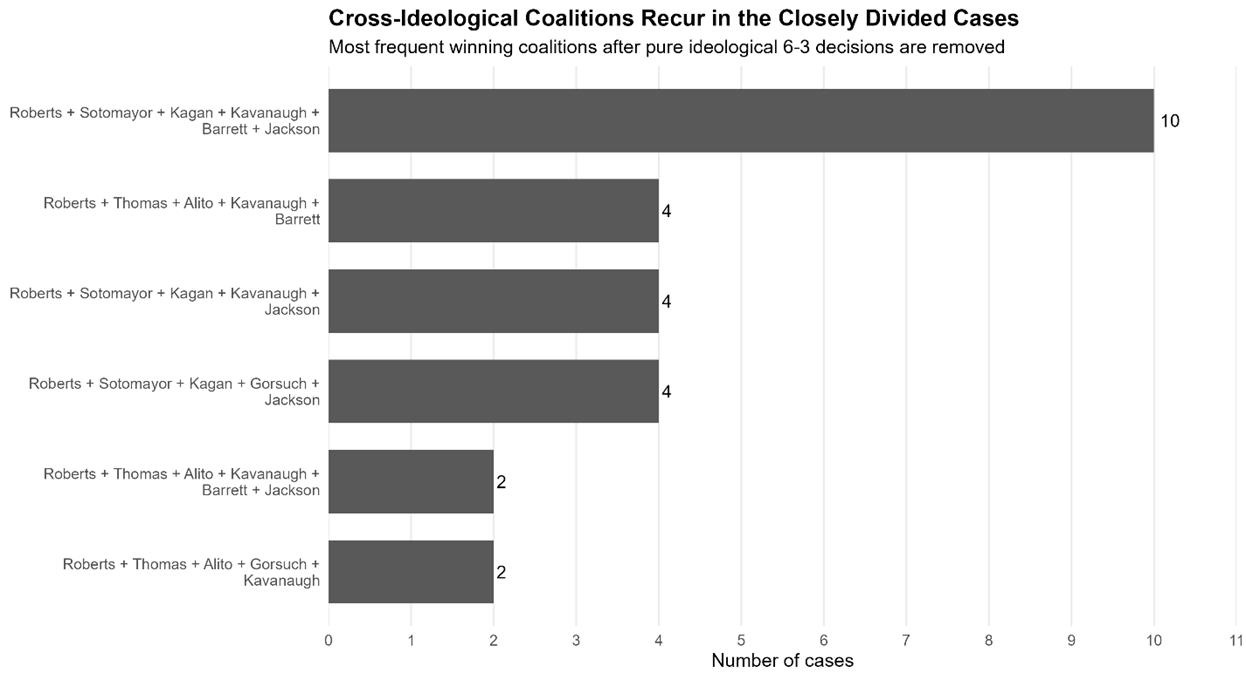
The most common is particularly striking. In 10 of the 44 remaining cases, the same six justices wind up on the prevailing ideological side: Roberts, Sotomayor, Kagan, Kavanaugh, Barrett, and Jackson. Thomas, Alito, and Gorsuch are on the other side.
That coalition appears in cases ranging from election law and criminal procedure to administrative law and health care. It includes Reed v. Goertz, Moore v. Harper, Warner Chappell Music v. Nealy, Murthy v. Missouri, Chiaverini v. City of Napoleon, Moyle v. United States, Gutierrez v. Saenz, Nuclear Regulatory Commission v. Texas, FCC v. Consumers’ Research, and Kennedy v. Braidwood Management.
The ideological coding of those cases is not identical. Eight produce liberal-coded outcomes in this dataset, while two produce conservative-coded outcomes. That is itself important. The recurring feature is the coalition, not necessarily a common liberal or conservative jurisprudence. Roberts, Kavanaugh, and Barrett repeatedly separate from Thomas, Alito, and Gorsuch in closely divided cases, and the three Democratic appointees frequently wind up on their side.
Moore v. Harper supplies perhaps the clearest example. The case involved the argument that the Elections Clause gives state legislatures authority over federal-election rules largely free from restrictions imposed by state constitutions and state courts. Roberts wrote the 6-3 opinion rejecting that broad theory, joined by Sotomayor, Kagan, Kavanaugh, Barrett, and Jackson. Thomas dissented with Gorsuch and, in part, Alito. The Court held that state legislatures exercising Elections Clause authority remain subject to ordinary state constitutional constraints and state judicial review.
That is hardly a low-salience case in which ideology would be expected to disappear. It concerned federal elections, partisan gerrymandering and a constitutional theory with potentially significant consequences for state control over election rules. Yet the division was not six Republican appointees against three Democratic appointees.
The same point emerges even more sharply from Allen v. Milligan. There, Roberts and Kavanaugh joined the three Democratic appointees in affirming a lower-court ruling that Alabama’s congressional map likely violated Section 2 of the Voting Rights Act. Roberts wrote that the Court was applying its existing Section 2 precedents rather than accepting Alabama’s proposed changes to the governing framework. Thomas, Alito, Gorsuch and Barrett dissented in whole or substantial part.
Allen is useful for this analysis because it was a 5-4, rather than a 6-3, decision. It shows that the pattern is not simply a quirk of how the 6-3 cases were classified. In one of the Court’s most politically salient voting-rights disputes of the period, Roberts and Kavanaugh supplied the votes necessary for a liberal-coded outcome.
Other cases scramble the conventional alignment even more thoroughly. In Harrington v. Purdue Pharma, the Court held 5-4 that the Bankruptcy Code did not authorize a Chapter 11 plan to extinguish claims against the Sackler family without the consent of affected claimants. Gorsuch wrote the majority opinion, joined by Thomas, Alito, Barrett—and Jackson. Kavanaugh dissented, joined by Roberts, Sotomayor and Kagan.
That lineup is difficult to describe using ordinary partisan shorthand. Four Republican appointees and Jackson formed the majority. Two other Republican appointees joined Sotomayor and Kagan in dissent. The dataset codes the prevailing result as liberal, but the more useful point for present purposes is that the case divided the justices along something other than their appointing party.
The same phenomenon remained visible the following Term. In FCC v. Consumers’ Research, the Court rejected a constitutional nondelegation challenge to the FCC’s universal-service funding system. Kagan wrote for Roberts, Sotomayor, Kavanaugh, Barrett and Jackson; Gorsuch dissented with Thomas and Alito.
Those examples put substance behind the averages. Roberts does not reach a 22-22 record in the non-pure cases because his votes are scattered randomly between two categories. He repeatedly participates in identifiable cross-ideological coalitions. The same is true, to different degrees, of Kavanaugh and Barrett.
Gorsuch is more complicated. He moves even farther statistically—from 15.7 points conservative among all closely divided cases to 2.3 points liberal after the pure 6-3s are removed—but he often gets there through different coalitions. His voting pattern is less closely tied to the Roberts-Kavanaugh-Barrett grouping. That fits the original merits analysis, which noted that Gorsuch’s frequent alignment with the Democratic-appointed justices could make his aggregate record look less conservative than conventional descriptions of his jurisprudence might suggest.
The Vote Count Does Not Tell You What Kind of Split It Was
This points to a distinction that gets lost when Supreme Court decisions are reduced to their margins. A 6-3 decision may represent the Court at its most ideologically predictable. In the 23 pure cases in this dataset, knowing the appointing party of each justice is enough to reconstruct every vote: six Republican appointees on the conservative-coded side, three Democratic appointees on the liberal-coded side.
But another 6-3 decision may tell almost the opposite story. Moore and FCC v. Consumers’ Research also ended 6-3. In both, Roberts, Kavanaugh and Barrett joined all three Democratic appointees against Thomas, Alito and Gorsuch.
The numerical division is the same. The ideological information contained in it is not. That distinction helps explain why the closely divided sample initially makes the Court look so polarized. The 23 pure 6-3 cases are unusually information-dense from an ideological perspective. Every vote in every one of those cases pushes all nine justices away from 50-50 in the direction predicted by the Court’s partisan composition. Repeating that pattern 23 times inevitably has a large effect on the aggregate scores.
The remaining cases work differently. Republican-appointed justices cross the ideological coding line, Democratic-appointed justices sometimes join them, and recurring coalitions emerge that do not correspond to the six-three partisan structure of the Court.
This does not make the pure ideological cases less important. If anything, their frequency is itself notable. Half of all 6-3 merits decisions in this four term sample divide in exactly the conventional ideological direction. A Court on which that happens regularly is plainly a Court in which ideology matters.
But treating all 6-3 decisions as equivalent risks overstating what follows from the vote margin alone. Some 6-3 cases confirm the Court’s partisan structure. Others reveal how frequently particular members of the six-justice conservative majority depart from it.
A Conservative Court, but Not a Six-Justice Ideological Unit
The original merits analysis described a conservative Court with poles on both sides and a center-right group of Republican appointees considerably closer to a balanced ideological voting record. The close-case analysis reinforces that description but also helps explain where it comes from.
If all 5-4 and 6-3 cases are placed together, the distinction nearly disappears. Roberts, Kavanaugh, Barrett and Gorsuch move sharply away from the middle, and the Court begins to look much more like two opposing ideological camps.
Separate out the 23 decisions in which the six Republican appointees vote together against the three Democratic appointees, however, and the earlier structure returns almost exactly. The average distance of Roberts, Kavanaugh, Barrett and Gorsuch falls from 16.8 points to 4.0—slightly below their 4.3-point average across all merits cases.
That is not what happens to the other five justices. Alito, Thomas, Sotomayor, Kagan and Jackson remain, on average, 26.8 points from 50/50 even after the pure ideological decisions are removed. Their close-case voting records remain considerably more directional than their records across the merits docket as a whole.
The resulting picture is therefore not one in which ideology disappears after a statistical adjustment. It is one in which ideology appears to operate differently across the Court.
Thomas and Alito remain strong conservative poles. Sotomayor, Kagan and Jackson remain strong liberal ones. Roberts, Kavanaugh and Barrett participate both in the Court’s conventional conservative majority and in a recurring set of cross-ideological majorities. Gorsuch follows a less conventional path but likewise becomes far less directional once the straight six-three cases are removed. That may be a more apt way to describe the modern Supreme Court than pure vote count.
The Court has a six-justice Republican-appointed majority, and in a substantial number of important cases that majority functions exactly as its composition would predict. But it does not function that way in every closely divided case. And when the cases in which it does are separated from those in which it does not, the difference between the Court’s ideological poles and its more fluid middle becomes hard to miss.
The first analysis showed that the cases included in an ideological measure can change where the justices appear to sit. The closest cases make that lesson even clearer. Sometimes a 6-3 Court really is six against three. Sometimes 6-3 tells a very different story.