

When the Transcript Predicts the Opinion: Measuring Oral Argument and Decision Congruence in Supreme Court’s 2025/2026 Term
How closely did oral argument and the Court's final decisions on the merits relate this past SCOTUS term? The answer carries a lot of variation but also some key consistent characteristics.

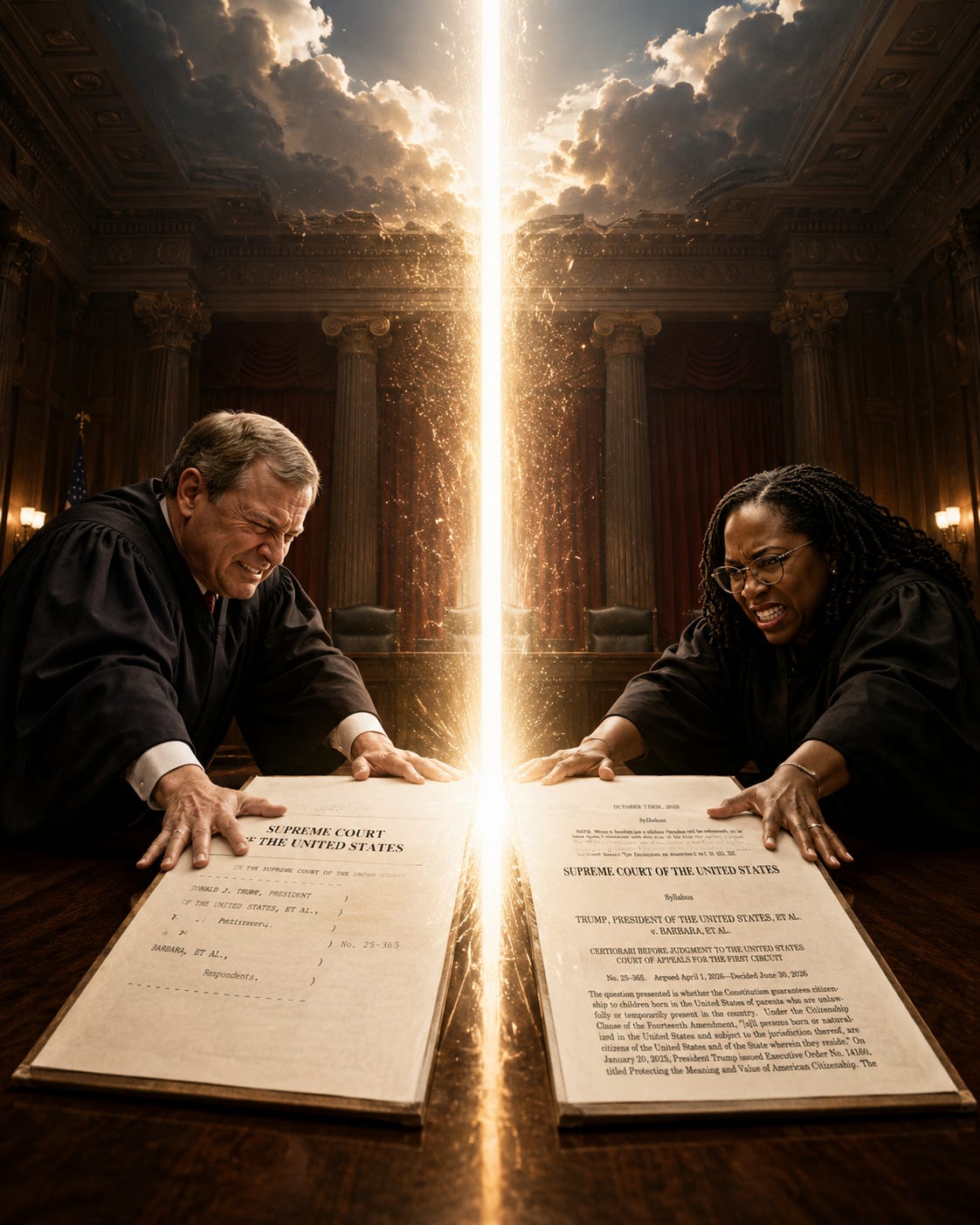
Supreme Court oral argument is sometimes treated as a forecasting exercise. Court watchers count questions, track interruptions, and listen for clues about which side has five votes. Sometimes the signals are obvious, sometimes they are misleading, and sometimes the most important part of argument is not who seemed to be winning, but which legal distinction the justices kept returning to.
That second question is the focus of this article. Instead of asking only whether oral argument predicted the winner, this article looks at how closely the Court’s final opinions tracked the issues, reasoning paths, limiting principles, and practical concerns developed at argument.
The resulting dataset covers 57 argued cases from the term. Each case was coded by comparing the oral argument transcript with the final opinion or opinions. The goal was to measure argument-decision congruence: how much the written decision reflected the argumentative structure aired in open court.
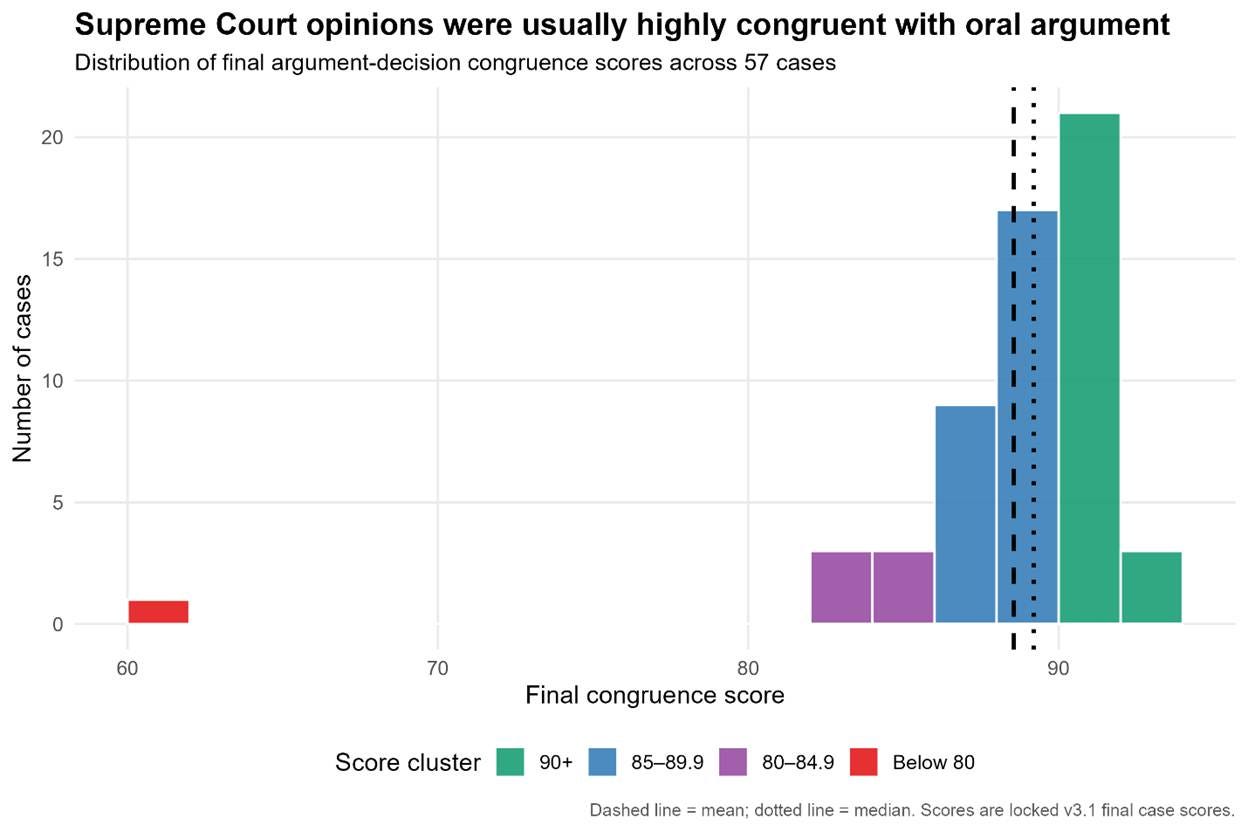
The key finding is that the Court’s opinions were usually highly congruent with oral argument. The average case scored 88.55 on a 100-point scale, with a median of 89.2. The range ran from 61.2 to 93.2, with a standard deviation of 4.37. Twenty-four cases scored 90 or higher. Another 26 fell between 85 and 89.9. Six scored between 80 and 84.9, and only one case fell below 70.
Those numbers point to a Court whose written decisions are, in most cases, built from the materials tested at argument. Oral argument may not always change votes, and this article’s goal is not to try to prove that it does. But the transcript often shows the architecture or foundation of the opinion to come.
A histogram should show the high-congruence concentration clearly: most cases clustered in the upper 80s and low 90s, with a small lower tail.
How the scores were built
The first step was to identify the major propositions developed at argument. These included the central legal rule, doctrinal tests, limiting principles, hypotheticals that framed the stakes, remedial concerns, and practical consequences the justices repeatedly explored. The second step was to code the final opinion or opinions for the propositions actually used in the decision. The third step was to match argument propositions to opinion propositions and classify the degree of overlap.
The final case score combined several components.
Coverage: measured how much of the central argument material appeared in the final decision.
Reasoning continuity: measured whether the opinion followed the same analytical route developed at argument.
Directional alignment: captured whether the opinion adopted the side or legal frame that the argument most strongly previewed.
Novelty: penalized opinions that introduced substantial new reasoning, resolved the case through an unexpected route, or left major argued questions unresolved.
Separate opinions, remands, emergency posture, and DIG-like outcomes were treated as factors that could reduce congruence when they made the final decision less directly comparable to the argument.
The Court was usually argument-faithful
The main empirical result is the overall concentration of high scores. 50 of the 57 cases, or about 88%, scored at least 85. That does not mean every decision was predictable in result. It means that in most cases, the Court’s written reasoning remained closely connected to the issues and distinctions tested at oral argument.
This may contradict some priors regarding oral argument. Oral argument is often framed as a moment of persuasion: did a lawyer win over a justice? That question is hard to answer from the outside. But the data support a more modest and more measurable claim. Oral argument is a public map of the Court’s reasoning constraints. It reveals which arguments the justices regard as viable, which limiting principles they need, and which doctrinal consequences they are trying to manage.
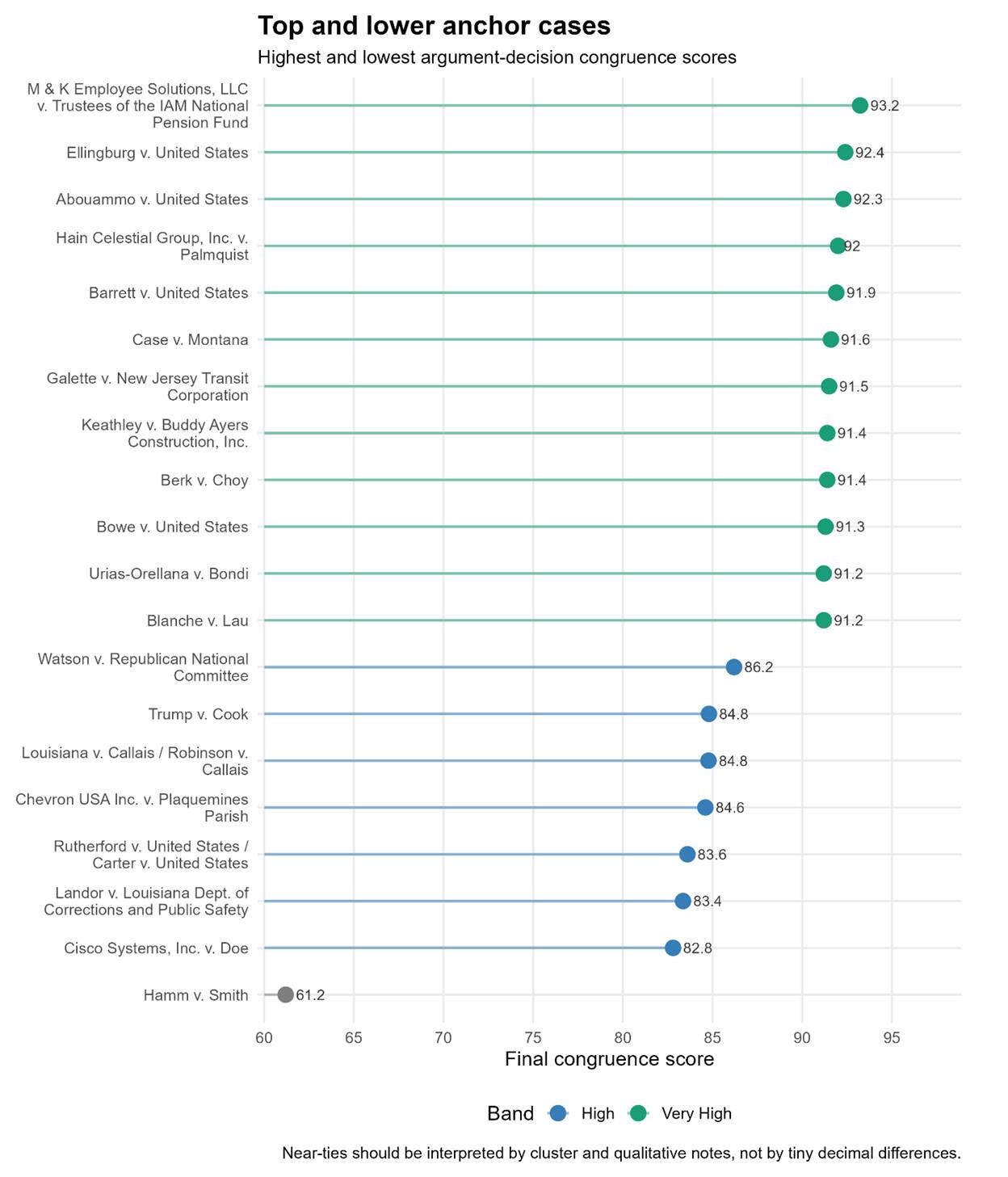
The highest scores in the dataset is dominated by cases where that map carried directly into the opinion. The highest-scoring case:
M & K Employee Solutions v. Trustees of the IAM National Pension Fund, scored 93.2;
It was followed by Ellingburg v. United States at 92.4;
Abouammo v. United States at 92.3;
Hain Celestial Group v. Palmquist at 92.0;
and Barrett v. United States at 91.9;
Those cases share a resemblance. They involved relatively bounded legal questions, the argument centered on a small number of decisive distinctions, and the final opinions used those same distinctions without major reframing.
Abouammo v. United States is the clearest example of this sequence . The case involved venue under 18 U.S.C. §1519, which criminalizes falsifying a document with intent to obstruct a federal investigation. At argument, the central dispute was whether venue belonged where the false document was created or where the investigation was located. The petitioner argued that the only essential conduct was falsification, which happened in Seattle. The government argued that the intended effect on a San Francisco investigation could support venue there.
The opinion followed the argument’s frame almost exactly. It identified falsification as the essential conduct element and held that venue lies where that conduct occurred. The case scored 92.3 because the Court’s opinion did not merely reach a result previewed at argument; it adopted the same conceptual path.
Keathley v. Buddy Ayers Construction, which scored 91.4, shows the same phenomenon in a different context. The argument focused on judicial estoppel after a bankruptcy debtor failed to disclose a later claim. The justices repeatedly tested whether the lower court’s knowledge-plus-motive rule was too rigid and whether equity required a broader look at mistake, intent, sophistication, attorney conduct, and prejudice. The final opinion adopted a totality-of-the-circumstances approach. The transcript and opinion were not identical, but they were working through the same problem in the same way.
Hain Celestial Group v. Palmquist, at 92.0, also scored near the top because the decision tracked the argument’s jurisdictional structure. The argument focused on whether an erroneous dismissal could cure a removal-jurisdiction defect. The final opinion’s reasoning remained closely tied to that issue and to the concern that an improper dismissal should not be allowed to manufacture federal jurisdiction.
These are the cases where oral argument most clearly functioned as a blueprint.
What actually drives congruence
The article’s most important validation comes from the component relationships. If the score were just a subjective impression, the internal measures would not necessarily converge. But they do.
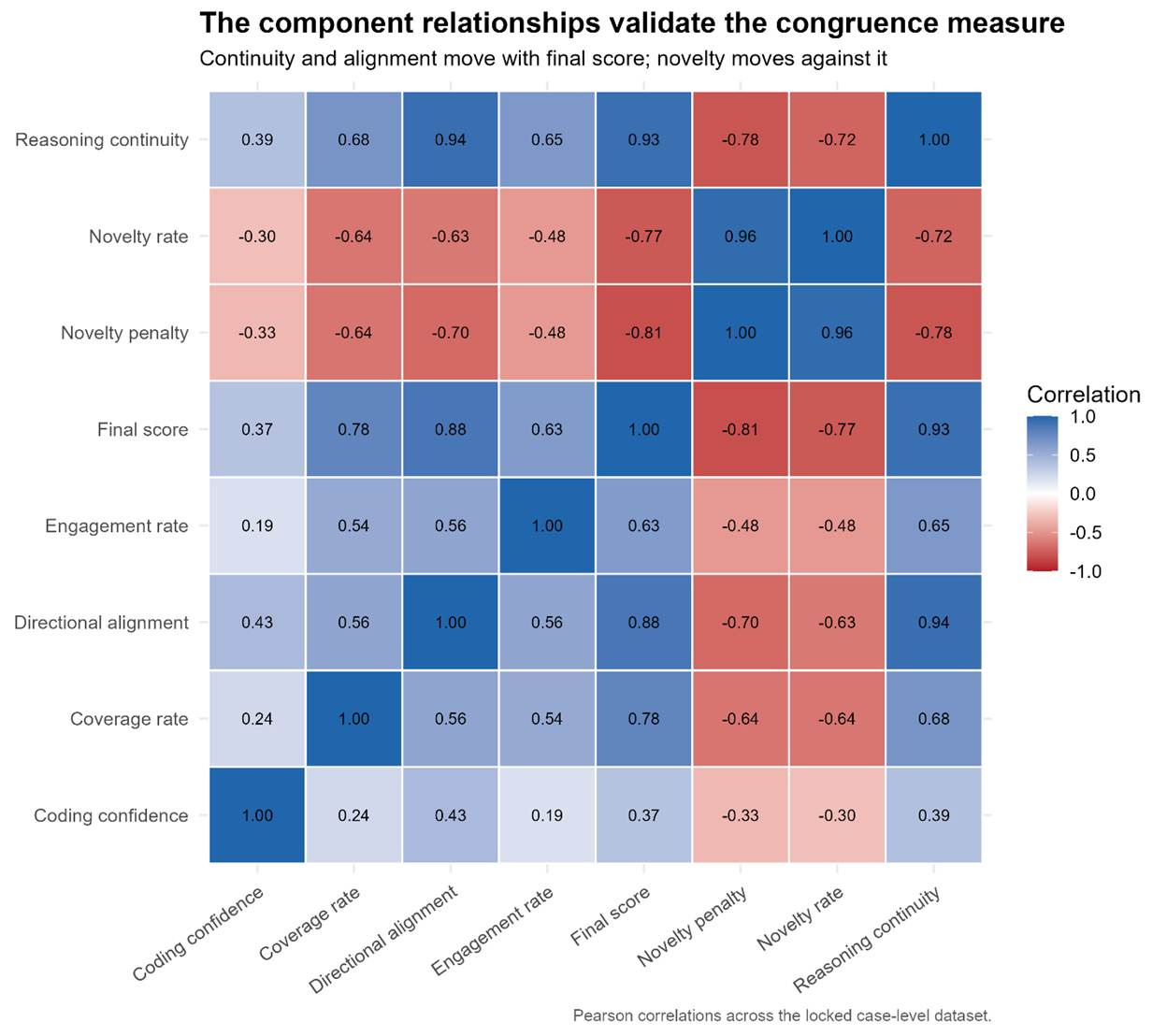
The strongest predictor of the final score was reasoning continuity, which correlated with the final score at about 0.93. That is exactly what one would expect if the measure is capturing argument-to-opinion fidelity. When the Court used the same analytical mechanism developed at argument, the score rose sharply.
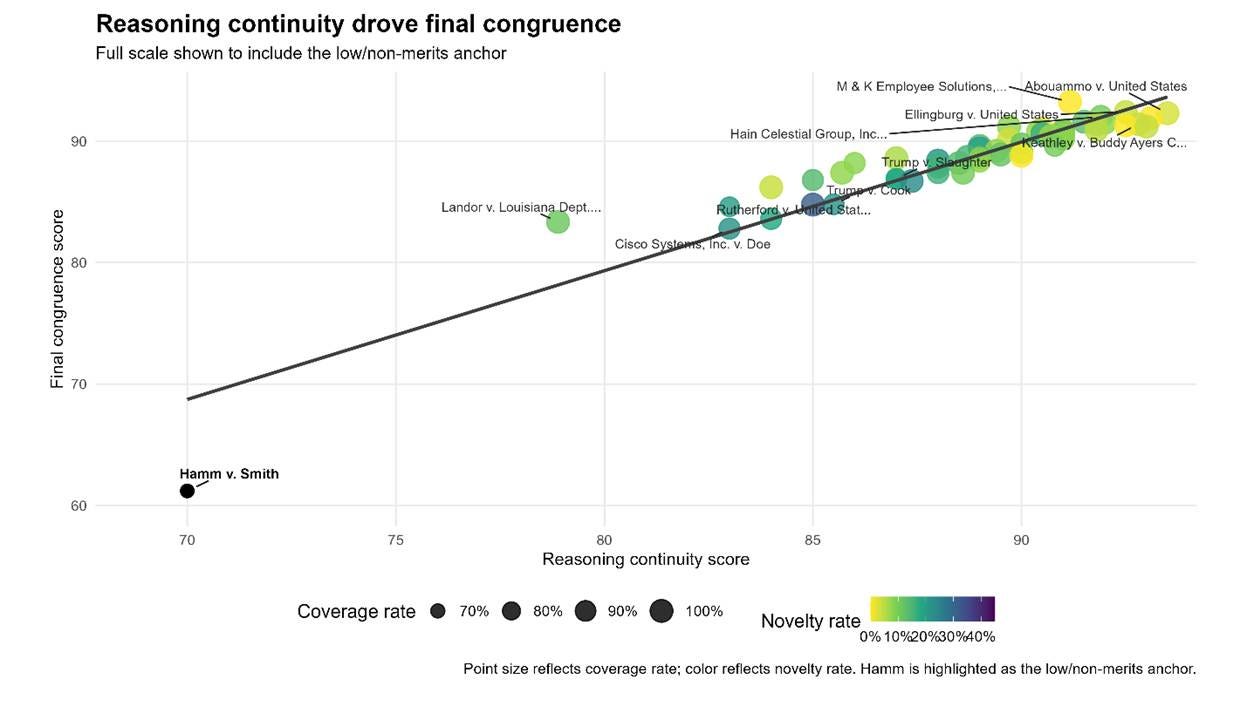
Directional alignment also had a strong positive relationship with the final score, at about 0.88. Cases scored higher when the final decision adopted the side, frame, or doctrinal orientation most clearly previewed at argument.
Coverage rate was also strongly positive, at about 0.78. Coverage alone did not do all the work though. A decision could mention many argued issues but still score lower if it resolved the case through a different conceptual route. That is why reasoning continuity was the stronger predictor.
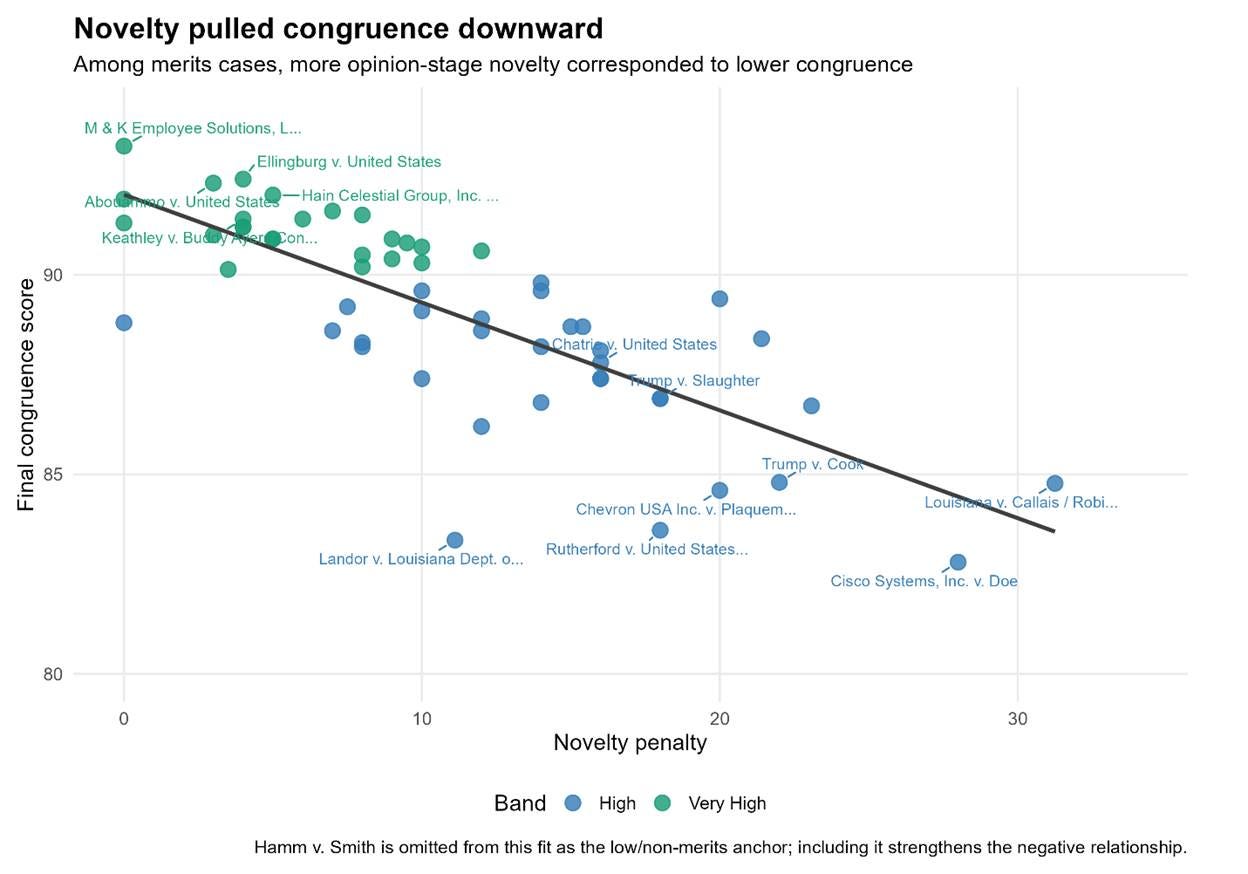
On the negative side, novelty mattered a lot. The novelty penalty correlated with final score at about -0.81, and the novelty rate correlated at about -0.77. When the Court added substantial reasoning not developed at argument, reserved important argued questions, or shifted to a different decisional posture, congruence dropped.
The lower-scoring cases were often more institutionally complicated
The lower end of the distribution is just as revealing as the top. The lowest case by far was Hamm v. Smith, at 61.2. It served as the dataset’s low/non-merits anchor. Where the Court does not decide the merits path argued, the final decision cannot closely track the argument in the ordinary way.
The next group of lower-congruence cases included Cisco Systems v. Doe at 82.8, Landor v. Louisiana Department of Corrections at 83.4, Rutherford v. United States / Carter v. United States at 83.6, Chevron USA v. Plaquemines Parish at 84.6, Louisiana v. Callais / Robinson v. Callais at 84.8, and Trump v. Cook at 84.8.
These were not necessarily minor cases. Several were among the term’s more consequential decisions. Their lower scores reflect the way institutional complexity can weaken the connection between argument and final opinion.
Trump v. Cook is a good example. The case concerned the attempted removal of a Federal Reserve governor and came to the Court in stay-application posture. The argument touched on presidential removal authority, the meaning of “cause,” Federal Reserve independence, process, remedies, and the institutional position of the central bank. The decision engaged many of those themes, but because the Court was addressing interim relief rather than issuing an ordinary merits decision, the opinion did not map as cleanly onto the argument. The result was still high congruence in ordinary terms, but low relative to the rest of the dataset.
Chatrie v. United States, which scored 87.8, shows a different kind of cap. The case involved Fourth Amendment limits on access to Google Location History data. The argument ranged across property concepts, reasonable expectations of privacy, the third-party doctrine, anonymization, probable cause, particularity, and good faith. The Court held that acquiring the location data was a search, but remanded the warrant-validity questions. The opinion tracked the argument’s privacy architecture, but it left significant argued material unresolved. That kept it below the top tier.
Trump v. Slaughter, at 86.9, shows how doctrinal ambition can reduce congruence. The argument previewed the central themes: Article II, Humphrey’s Executor, the modern FTC, remedies, and the structure of independent agencies. But the final decision carried broad separation-of-powers consequences and generated meaningful separate-opinion divergence. It was connected to the argument, but it also did more than simply decide along the argument’s narrowest path.
The lower-scoring cases therefore do not show that oral argument was unimportant. They show that argument has different roles in different kinds of cases. In a clean statutory case, it may supply the rule. In a structural constitutional case, it may expose the competing frameworks later distributed across majority, concurrence, and dissent. In an emergency or stay case, it may shape the Court’s assessment of risk rather than produce a conventional merits rationale.
The term’s pattern: ordinary cases were more argument-faithful than institutionally charged ones
One of the clearest term-level patterns is the contrast between bounded legal disputes and institutionally charged cases.
Narrow statutory, procedural, and criminal-law cases tended to produce the cleanest argument-to-opinion translation. Abouammo, Hain Celestial, Barrett, Keathley, Bowe, Blanche v. Lau, and FCC v. AT&T / Verizon v. FCC all scored above 90 or close to it because the Court’s reasoning stayed close to the questions tested at argument.
By contrast, cases involving executive power, immigration policy, emergency relief, agency independence, race and election law, or digital privacy often had more complicated congruence profiles. These cases still generally scored high, but they more often involved novelty penalties, reserved issues, separate opinions, or posture effects.
This is one of the project’s more important findings. The cases most watched by the public are not always the cases where oral argument best predicts the final opinion. High-salience cases often require the Court to manage institutional risk, coalition maintenance, future litigation, and separate writings. That additional layer can make the opinion less directly congruent with the argument even when the major themes were previewed.
The justices: small differences, real style signals
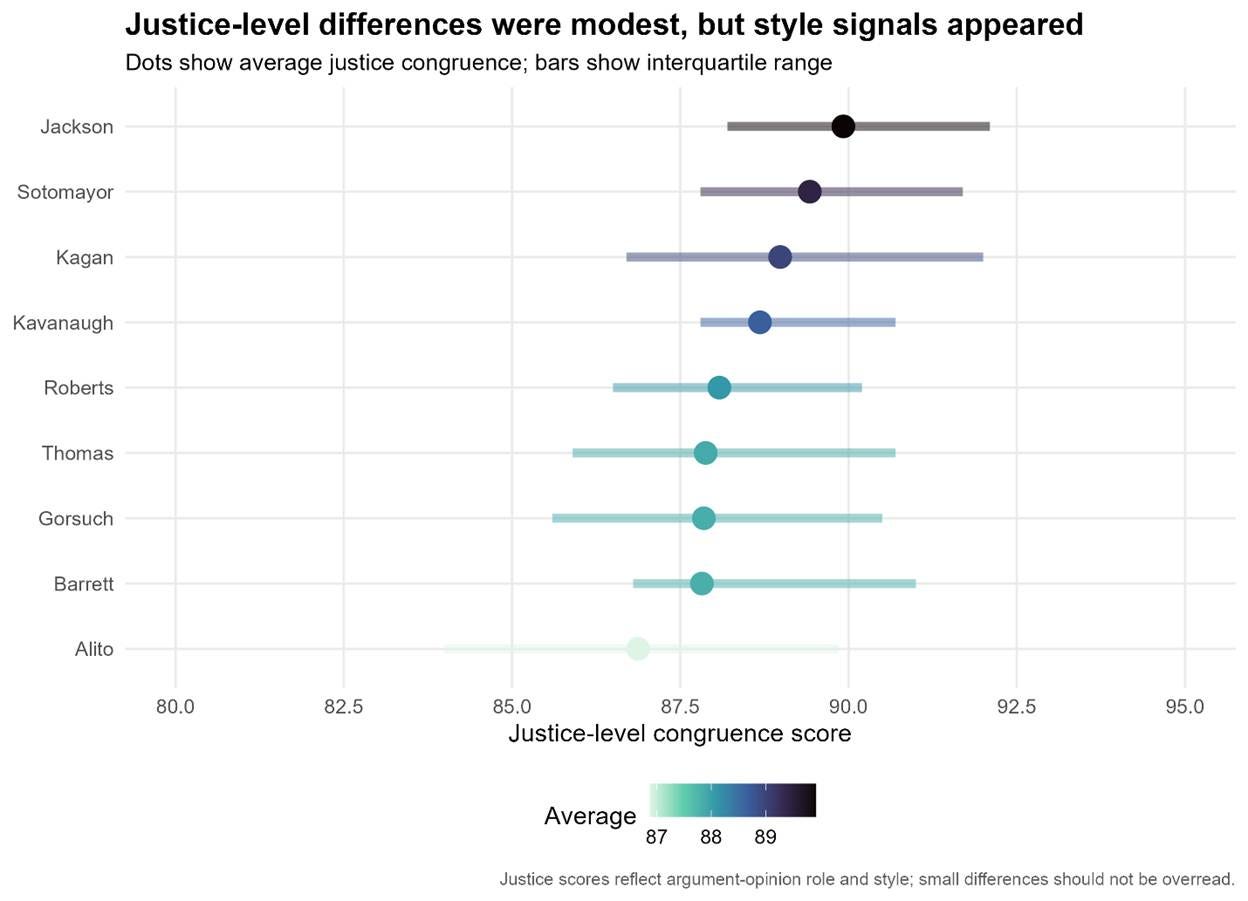
Justice-level comparisons require caution. The average justice scores clustered tightly, and the differences should not be treated as a ranking of judicial quality. Still, the patterns are interesting.
Justice Jackson had the highest average justice-level congruence, at about 89.8. Justice Sotomayor followed at about 89.4, and Justice Kagan at about 89.0. Justice Kavanaugh averaged about 88.5. Justices Thomas, Roberts, Barrett, and Gorsuch clustered around 88.1 to 88.2. Justice Alito was somewhat lower, at about 87.3.
The spread from top to bottom is modest. The more useful interpretation is stylistic. Justice Jackson’s argument contributions often pressed administrability, consequences, and the real-world operation of legal rules. When those concerns appeared in opinions, her score rose. Justices Sotomayor and Kagan frequently framed cases around doctrinal fit, procedural consequences, and how proposed rules would operate beyond the immediate dispute. Chief Justice Roberts and Justice Kavanaugh often appeared as institutional narrowers, focusing on limiting principles and systemic consequences.
Justices Thomas and Gorsuch frequently raised historical or structural frames. Those questions sometimes appeared in majority opinions, but they also often surfaced in separate writings. That can complicate the score because the justice may be highly congruent with a concurrence even if the Court’s controlling rationale takes a different path. Justice Alito’s lower average appears partly connected to separate-opinion behavior and cases in which his argument path was preserved in dissent rather than adopted by the Court.
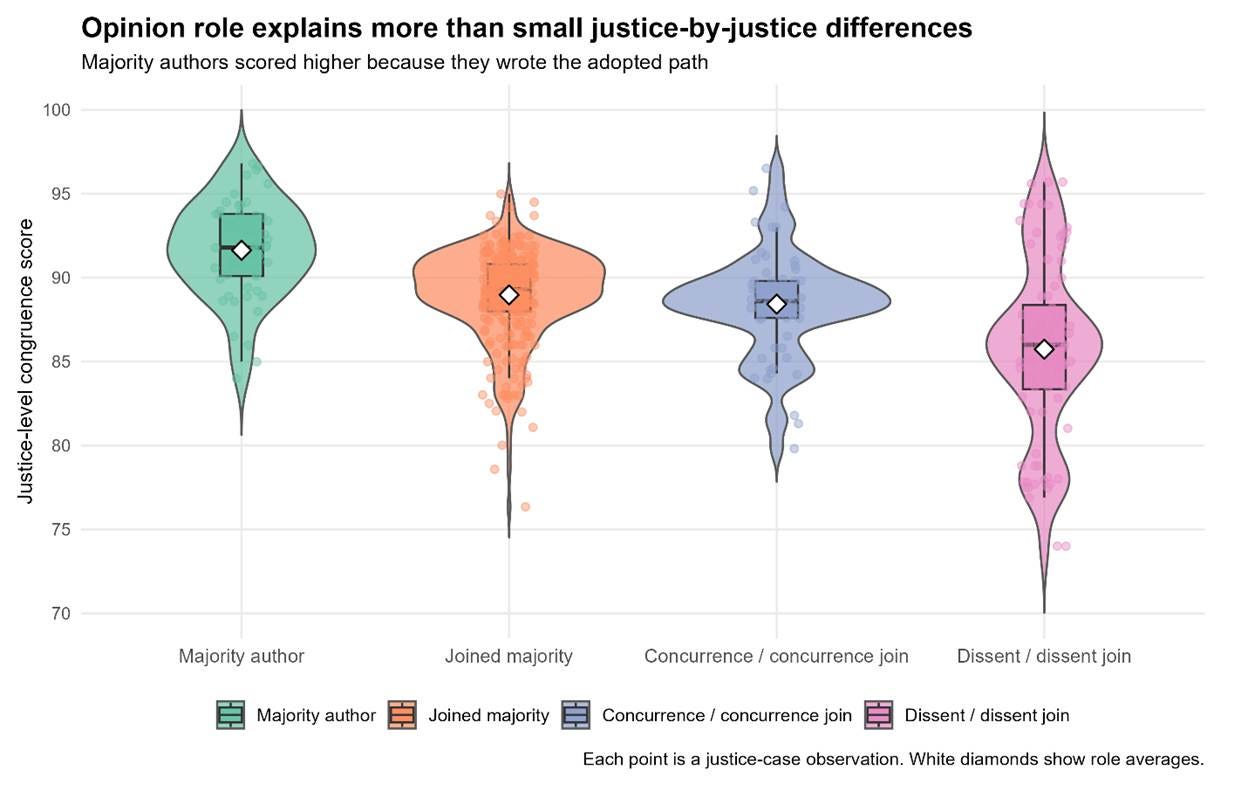
Role matters more than identity. Majority authors averaged about 91.4, while dissent authors averaged about 86.7. That is unsurprising. The majority author writes the Court’s adopted path. A dissent author may be faithful to argument, but if the Court rejects that path, the justice’s score will often be lower relative to the final controlling decision.
What the data says about reading oral argument → opinions
The most predictive moments in oral arguments were not always the sharpest exchanges. They were the recurring points: the distinction several justices kept testing, the limiting principle that survived multiple hypotheticals, the statutory phrase that kept returning, or the remedial consequence no side could avoid.
That was true in Abouammo, where the repeated focus on essential conduct forecast the venue holding. It was true in Keathley, where the argument’s pressure on rigid judicial-estoppel rules forecast the Court’s equitable totality approach. It was true in Chatrie, where the privacy concerns surrounding Location History forecast the search holding, even though the warrant questions were left for remand.
Oral argument did not predict everything. It was less predictive when the Court changed posture, avoided the merits, wrote broadly, fractured across opinions, or reserved important questions. But even in those cases, the argument often previewed the competing frameworks that later appeared in separate opinions.
That may be the best way to understand the Court’s use of argument. It is not simply a forum for changing minds. It is a public test of opinion language, doctrinal fit, limiting principles, and institutional consequences. In most cases this term, the test left a visible imprint on the final decision.
The dataset conveys that Supreme Court oral argument is generally strongly predictive of the content and structure of the Court’s opinions. Across 57 cases, the average congruence score was 88.55, and nearly nine in ten cases scored at least 85. The strongest driver was reasoning continuity, while the strongest negative factor was novelty.
That does not mean oral argument determines outcomes. It means something more precise: the Court’s written opinions usually remain connected to the adversarial process that preceded them.
Advocates might find interesting the importance of argument as a place to supply the Court with usable reasoning, not just a final chance to persuade. For court watchers, it suggests that the best clues are not always in the apparent vote count. They are in the questions the justices cannot let go.
The justices may not always reveal where they will land. But in most cases, they reveal the shape of the opinion to come.