

Eleven Things About The Second Longest Serving Justice of All Time
Ten data points that provide a unique portrait of the decisions of the second longest serving justice across the Court's history.

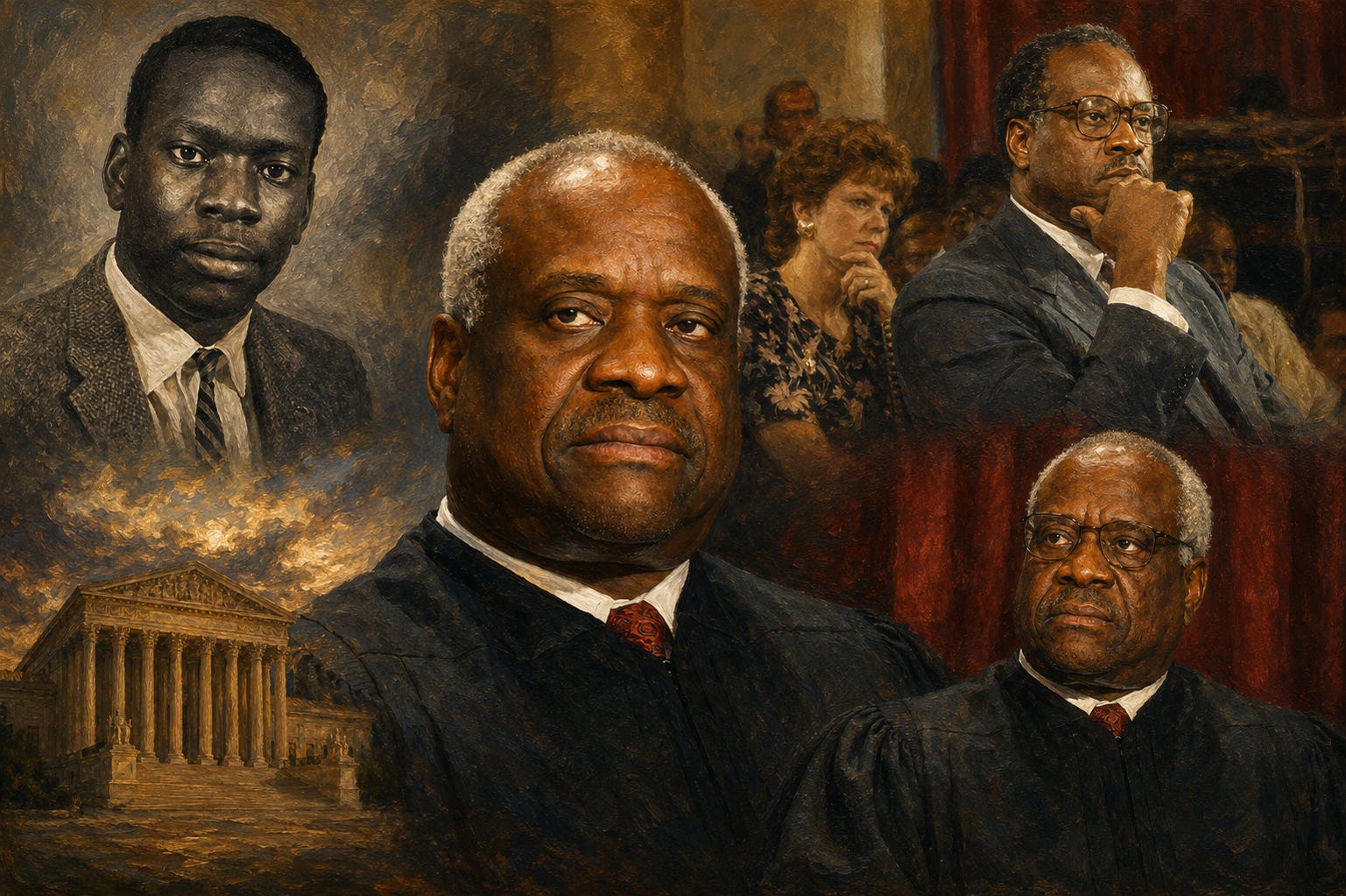
Justice Clarence Thomas, now the second-longest-serving justice in Supreme Court history, has occupied a singular place on the court for more than three decades. Born in 1948 in Savannah, Georgia, and raised in Pin Point, Thomas came to the court with a background that differed sharply from many of his predecessors: Catholic, African American, Southern, and from a lower-income family, with no family tradition in the law or judiciary. The Supreme Court Justices Database identifies his father, M.C. Thomas, as a farm worker and lists Thomas’s childhood community as a small town in Georgia.
Thomas graduated from the College of the Holy Cross in 1971 and Yale Law School in 1974. After law school, he was admitted to the Missouri bar and began his career as an assistant attorney general in Missouri from 1974 to 1977. He then worked as an attorney for Monsanto in St. Louis from 1977 to 1979, before joining the office of Sen. John Danforth as a legislative assistant from 1979 to 1981. His federal executive-branch experience followed quickly: assistant secretary for civil rights at the Department of Education from 1981 to 1982, and then chairman of the Equal Employment Opportunity Commission from 1982 to 1990. The Federal Judicial Center lists the same career path, including his service at the Department of Education and EEOC before his judicial appointments.
President George H.W. Bush first nominated Thomas to the U.S. Court of Appeals for the District of Columbia Circuit on Oct. 30, 1989, to fill the seat previously held by Robert Bork. The Senate confirmed him by voice vote on March 6, 1990, and his commission issued the same day. His time on the D.C. Circuit was brief: In July 1991, Bush nominated him to succeed Justice Thurgood Marshall on the Supreme Court. The Senate Judiciary Committee reported the nomination without recommendation, and the full Senate confirmed Thomas by a 52-48 roll-call vote on Oct. 15, 1991. He received his Supreme Court commission on Oct. 18, 1991, and took his seat on Oct. 23, 1991.
The nomination itself remains one of the most closely contested in modern Supreme Court history. The Justices Database records an ABA rating of “qualified,” a divided committee process, 11 hearing days, and a final Senate vote of 52 supporters and 48 opponents. Those numbers help frame the long arc of Thomas’s tenure: A justice confirmed by one of the narrowest margins in the court’s modern history has become one of its most institutionally durable and jurisprudentially consequential members.
1) Length of service
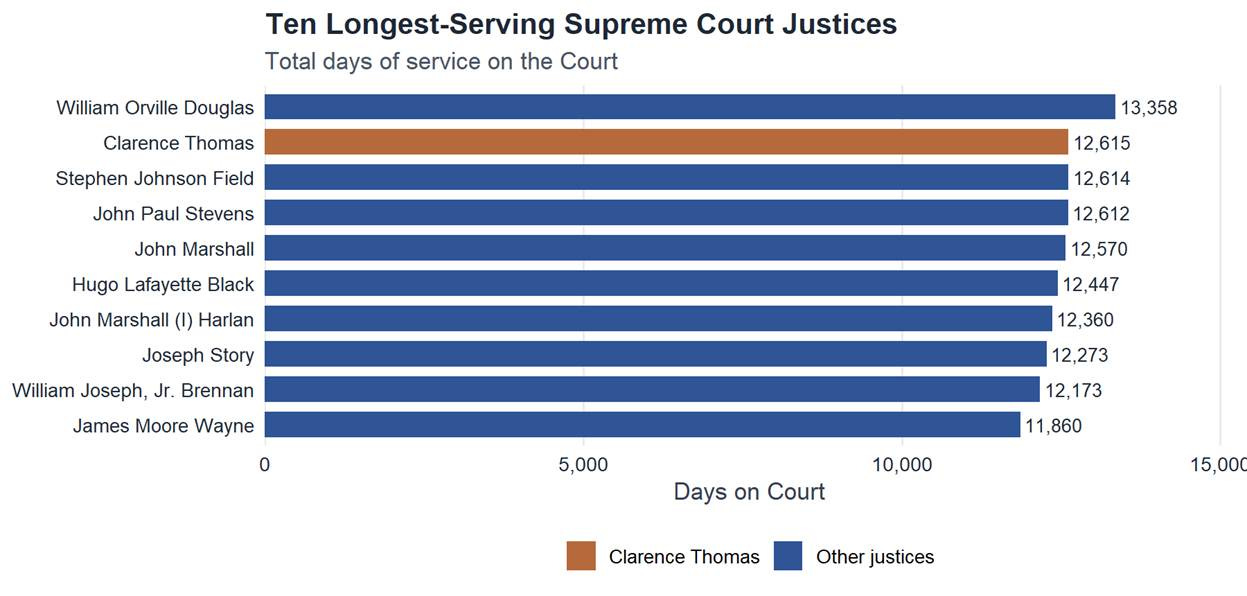
Measured by total days of service on the Supreme Court, Clarence Thomas now sits essentially at the top of the court’s longevity list. William O. Douglas remains first, with 13,358 days, but Thomas’s 12,615 days place him second—just ahead of Stephen J. Field, John Paul Stevens, John Marshall, Hugo Black, John Marshall Harlan, Joseph Story, William Brennan, and James Wayne. The ranking is striking because it places Thomas not merely among long-serving modern justices, but in a historical group that spans nearly the entire life of the court, from early institutional figures like Marshall and Story to 20th-century constitutional giants like Douglas, Black, Brennan, and Stevens. His length of service has given him an unusually long runway to move from an isolated voice on the court’s right flank to a justice whose originalist and text-centered approach now often shapes the court’s direction.
2) Age
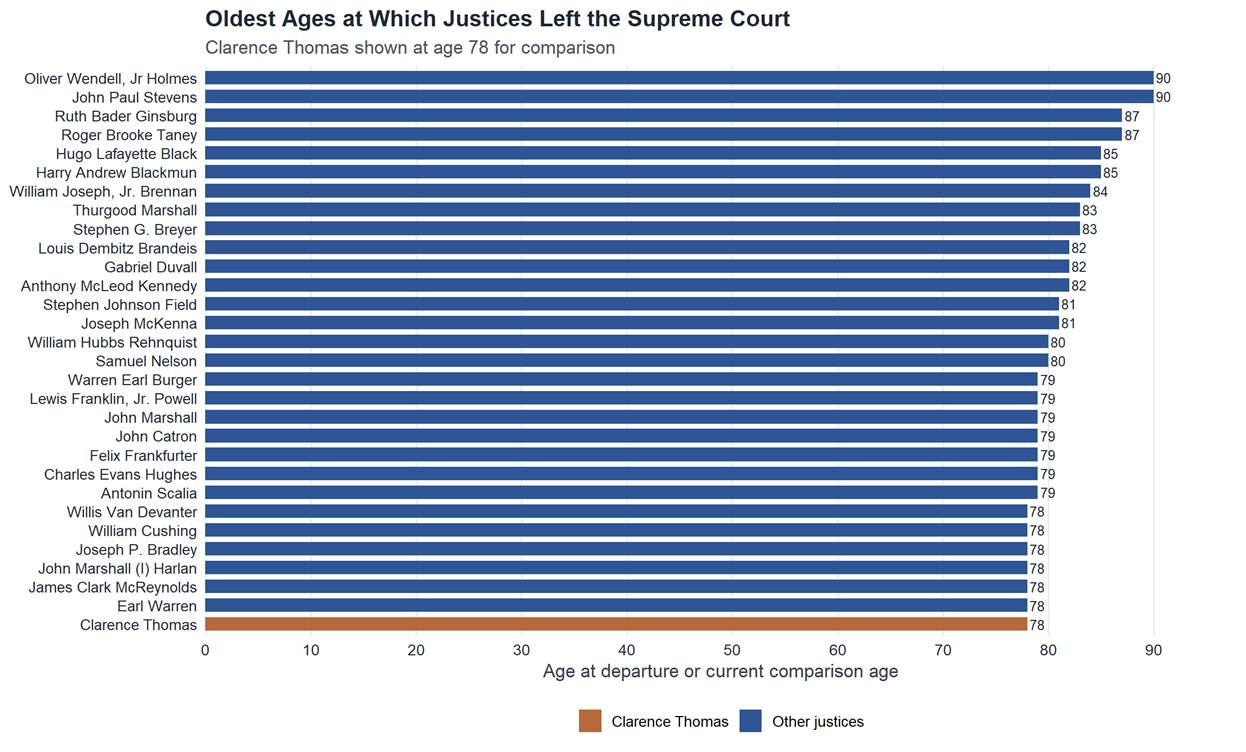
At age 78, Clarence Thomas would be entering the lower end of the court’s oldest-departure range rather than its extreme upper tier. Six justices in this comparison left the court at age 78: Joseph P. Bradley, Earl Warren, John Marshall Harlan, Willis Van Devanter, William Cushing, and James McReynolds. Another 23 justices left at older ages, including William Rehnquist and Samuel Nelson at 80; Stephen Field and Joseph McKenna at 81; Anthony Kennedy, Louis Brandeis, and Gabriel Duvall at 82; Thurgood Marshall and Stephen Breyer at 83; William Brennan at 84; Hugo Black and Harry Blackmun at 85; Roger Taney and Ruth Bader Ginsburg at 87; and Oliver Wendell Holmes and John Paul Stevens at 90. The comparison underscores a central feature of Thomas’s position: although he is already one of the longest-serving justices in history, he is not yet among the very oldest justices to serve, meaning that his tenure is historically extraordinary because of its early start and long duration, not simply because of age.
3) Most cited opinion
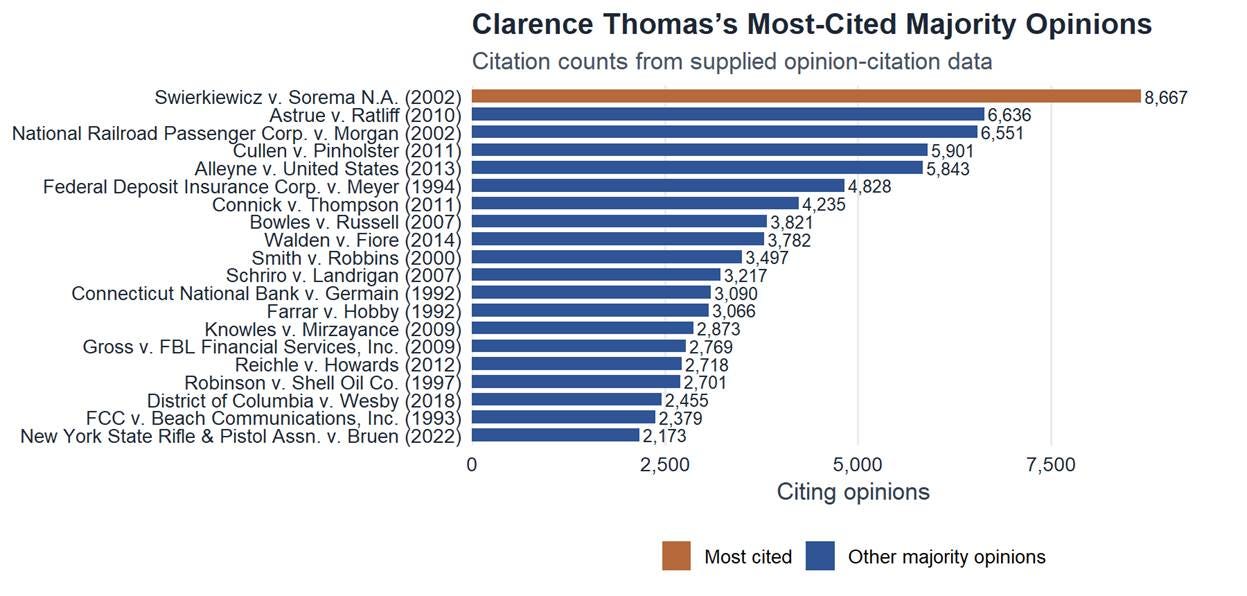
Thomas’s most-cited majority opinions according to CourtListener’s data show the breadth of his influence outside the headline constitutional cases most associated with him. His highest-cited majority opinion in this set is Swierkiewicz v. Sorema N.A., a 2002 civil-procedure and employment-discrimination pleading decision cited by 8,667 opinions, followed by Astrue v. Ratliff with 6,636 citations and National Railroad Passenger Corp. v. Morgan with 6,551. The list is striking because many of the leading cases are not culture-war landmarks but workhorse precedents in civil procedure, employment law, habeas, jurisdiction, statutory interpretation, qualified immunity, and personal jurisdiction. More recent constitutional decisions are also beginning to appear, most notably New York State Rifle & Pistol Association v. Bruen, which already has 2,173 citing opinions despite being decided in 2022. Together, the cases suggest that Thomas’s majority-opinion legacy is not only ideological or theoretical; it is also deeply embedded in the day-to-day citation network of federal and state courts.
4) Number of total opinions
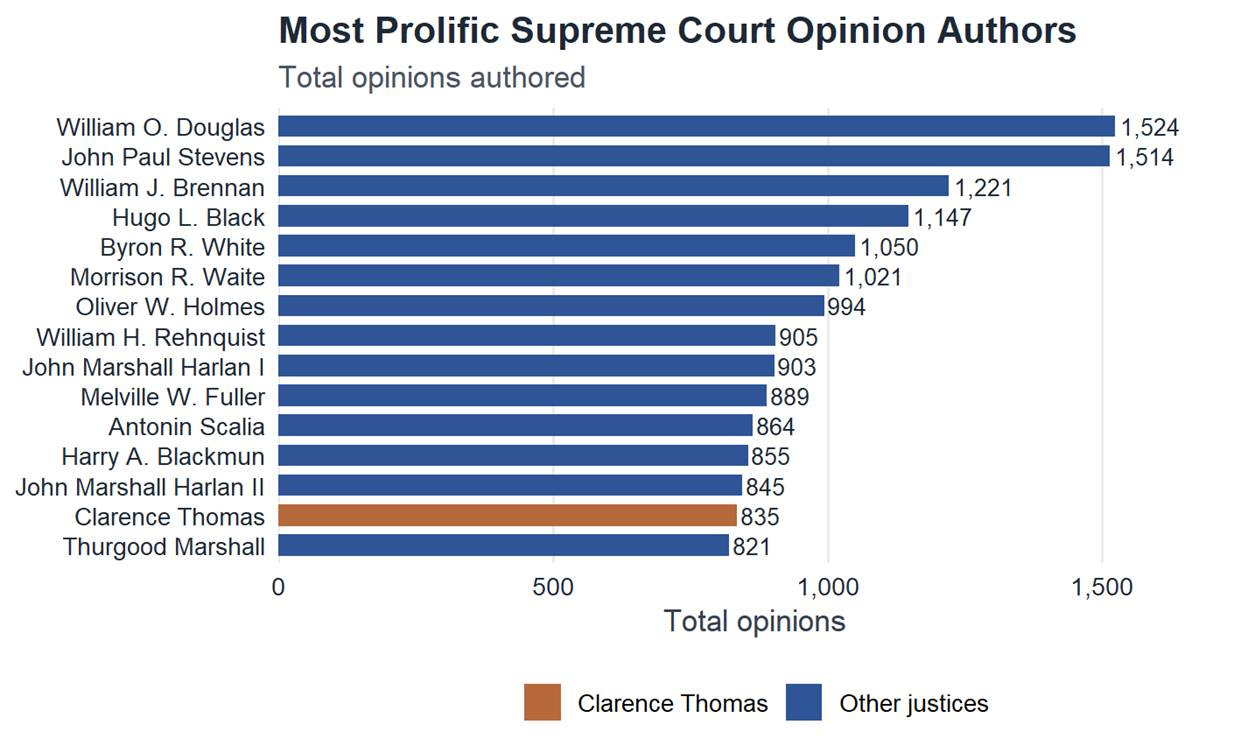
Thomas’s output also places him among the court’s most prolific opinion writers. With 835 total opinions, including 10 so far this term, he ranks just below Harry Blackmun, Antonin Scalia, Melville Fuller, John Marshall Harlan II, and John Marshall Harlan I, and just ahead of Thurgood Marshall. The comparison is useful because it separates longevity from output: Thomas is already the second-longest-serving justice, but in total opinions he falls lower on the historical list than William O. Douglas, John Paul Stevens, William Brennan, Hugo Black, Byron White, and several others. That reflects both the modern court’s smaller merits docket and Thomas’s particular role as a justice who has often written separately — sometimes in concurrences or dissents that later became doctrinal markers — while authoring fewer total opinions than some earlier justices who served during higher-volume eras.
5) Joined most / Most opposed
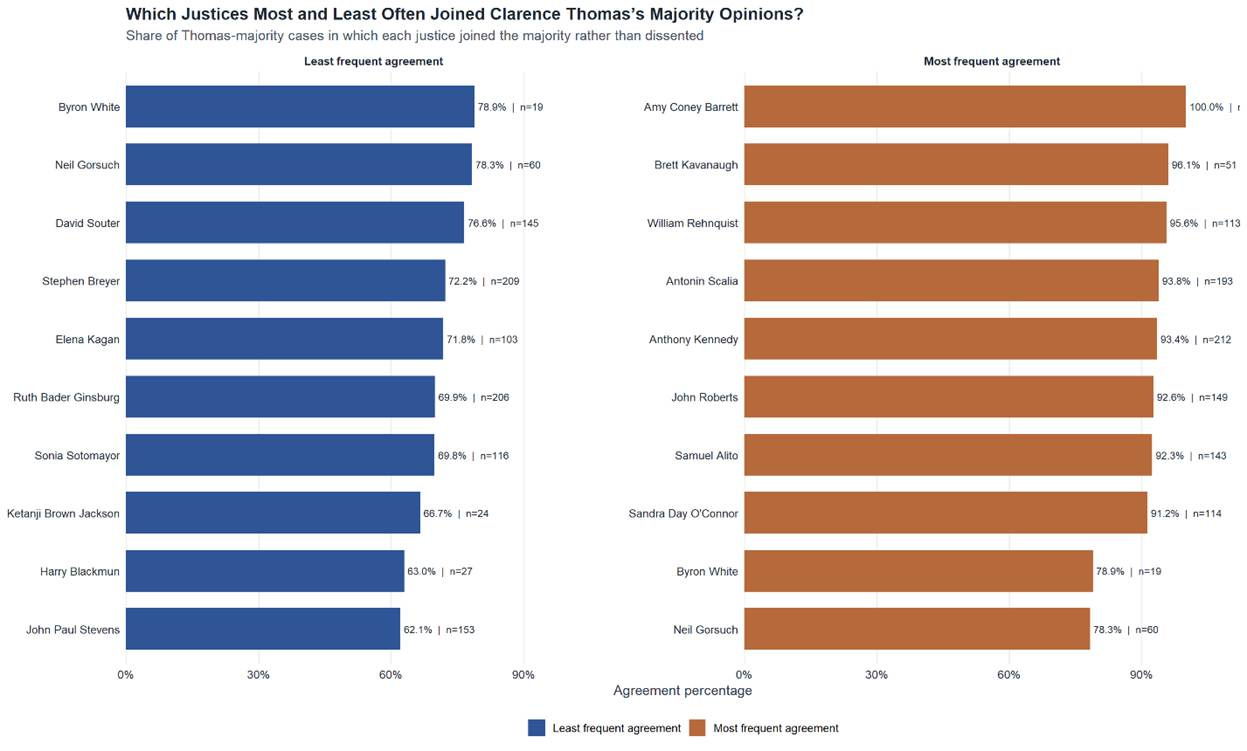
Thomas’s majority opinions have generally drawn their strongest support from the court’s conservative justices, but the pattern is not simply ideological. Amy Coney Barrett has joined Thomas-written majorities in all of their shared cases in this dataset, though the sample is still relatively small at 24 cases. Brett Kavanaugh follows at 96.1%, with William Rehnquist at 95.6%, Antonin Scalia at 93.8%, Anthony Kennedy at 93.4%, John Roberts at 92.6%, Samuel Alito at 92.3%, and Sandra Day O’Connor at 91.2%. The least frequent joiners are mostly the court’s more liberal members during Thomas’s tenure: John Paul Stevens joined 62.1% of Thomas majorities, Harry Blackmun 63.0%, Ketanji Brown Jackson 66.7%, Sonia Sotomayor 69.8%, Ruth Bader Ginsburg 69.9%, Elena Kagan 71.8%, and Stephen Breyer 72.2%. The notable outliers are Neil Gorsuch and Byron White, who appear in both the bottom and top panels because the dataset has fewer than 20 non-Thomas justices and because each still joined roughly four-fifths of Thomas’s majorities, underscoring that even Thomas’s least frequent partners often agreed with the judgment when he was assigned the court’s opinion
6) Oral argument Engagement
Thomas’s oral-argument silence became one of the most distinctive features of his public identity on the court. After asking a question from the bench on Feb. 22, 2006, he went nearly 10 years without asking another substantive question during oral argument, breaking that silence on Feb. 29, 2016, in Voisine v. United States, a Second Amendment-related case involving whether misdemeanor domestic-violence convictions could trigger a federal firearms ban. The moment drew notice precisely because it interrupted a decade-long pattern: Thomas had long defended his restraint as a matter of courtroom courtesy, arguing that the justices should let advocates present their arguments rather than constantly interrupting them. Even after the 2016 exchange, he remained a relatively rare participant at argument, with only limited exceptions — including a brief joke in 2013 — until the court’s telephonic arguments during the COVID-19 pandemic changed the format. Under Chief Justice John Roberts’ turn-taking system, each justice received a distinct opportunity to question counsel, and Thomas began speaking regularly; in the first four telephonic arguments, he participated in each one, after taking no speaking turns in the four most recent pre-pandemic arguments. The shift did not transform Thomas into one of the court’s most active questioners — he still spoke the fewest words among the justices in each of those four new-format arguments — but it showed that his silence correlated with, at least partly, the free-for-all structure of traditional oral argument.
7) Number of solo dissents
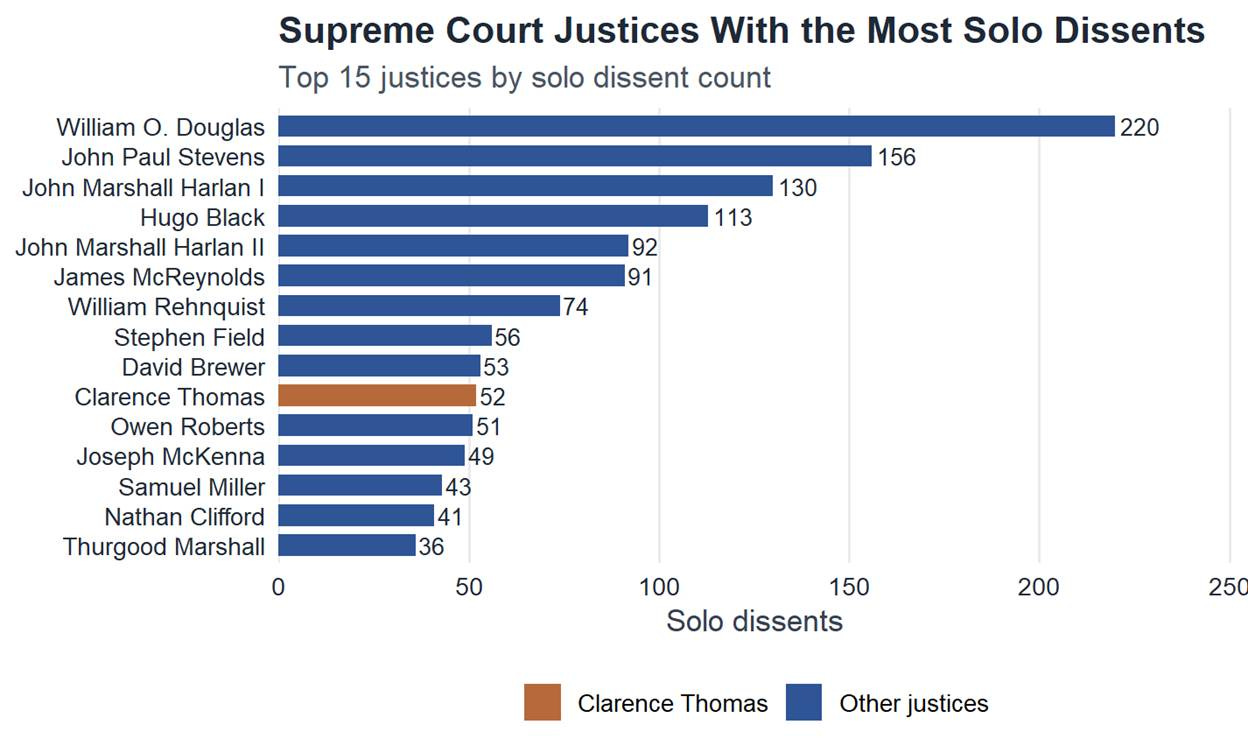
Thomas’s solo dissents are one of the clearest statistical markers of his independence on the court. With 52 solo dissents, he ranks 10th in the data provided here, placing him behind William O. Douglas, John Paul Stevens, John Marshall Harlan I, Hugo Black, John Marshall Harlan II, James McReynolds, William Rehnquist, Stephen Field, and David Brewer. The number is especially striking in modern context: among the current justices, Sonia Sotomayor is the closest at 18 solo dissents, while Samuel Alito has 13, Neil Gorsuch has eight, Ketanji Brown Jackson has three, and John Roberts and Brett Kavanaugh each have one. Thomas therefore has nearly three times as many solo dissents as Sotomayor and four times as many as Alito, even though he has served during an era in which the court has been, on balance, conservative throughout his tenure. That nuance matters: Thomas’s solo dissents are not simply the record of a conservative justice resisting a liberal court; they reflect a justice often willing to stand apart even from conservative colleagues when he believes precedent, constitutional text, or original meaning points further than the court is prepared to go.
8) Most reversed circuit
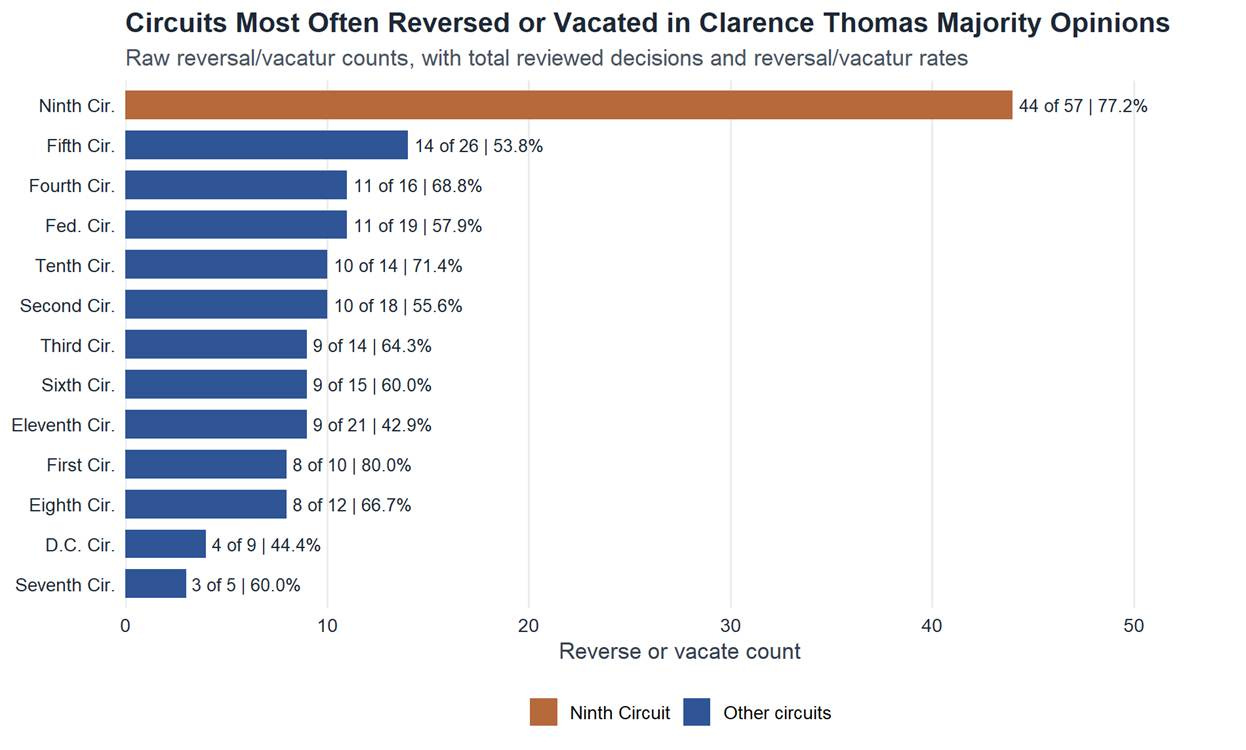
Thomas’s majority opinions have most often reversed or vacated decisions from the 9th Circuit, by a wide margin. In the data provided here, Thomas wrote 57 decisions reviewing 9th Circuit rulings, and 44 of them reversed or vacated the lower court, a rate of 77.2%. The next-largest raw totals are much lower: 14 reversals or vacaturs from the 5th Circuit, 11 each from the 4th and Federal Circuits, and 10 each from the 2nd and 10th Circuits. Looking at percentages adds a slightly different perspective: the 1st Circuit had the highest reversal/vacatur rate at 80.0%, followed by the 9th Circuit at 77.2%, the 10th Circuit at 71.4%, and the 4th Circuit at 68.8%. Together, the numbers show both the 9th Circuit’s unusually large presence in Thomas’s reversal docket and the broader pattern that, when Thomas writes for the court, the lower-court decision under review is usually reversed or vacated across most circuits in this set.
9) Most issue area written
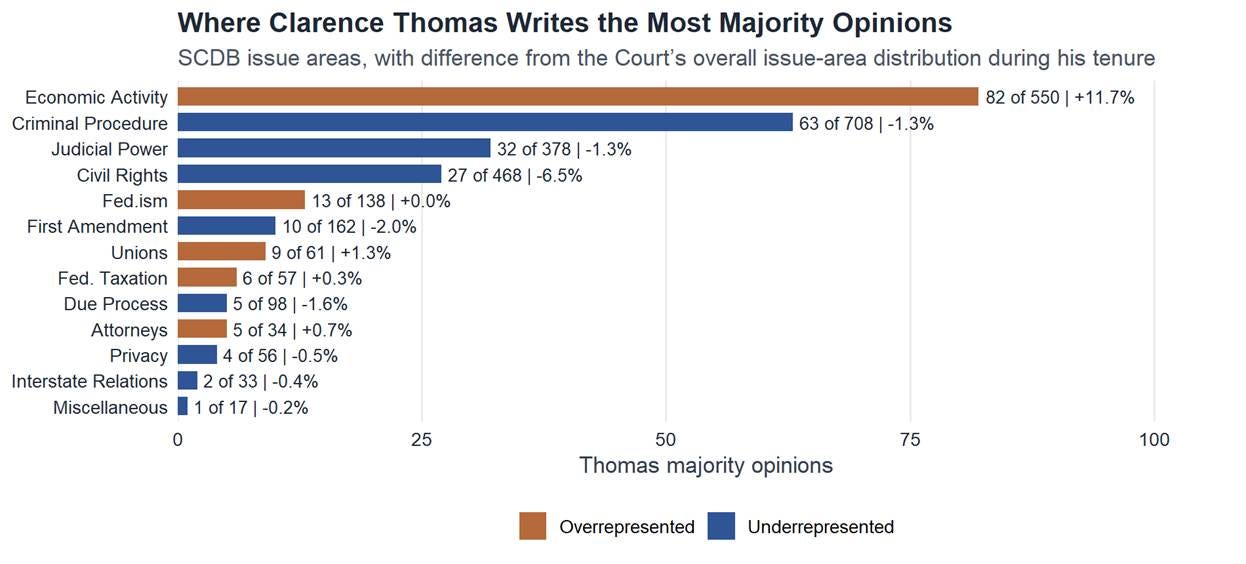
Based on Supreme Cout Database coding, Thomas’s majority-opinion assignments are concentrated most heavily in economic-activity cases. In the data provided here, he authored 82 majority opinions in that issue area, well ahead of criminal procedure with 63, judicial power with 32, and civil rights with 27. The comparison with the court’s full issue-area distribution during Thomas’s tenure sharpens the point: economic activity is also the area where Thomas is most overrepresented, with his share of majority authorships running about 11.7 percentage points above the court’s overall share of cases in that category. By contrast, he is underrepresented in civil rights by about 6.5 percentage points, First Amendment cases by about 2.0 points, due process by about 1.6 points, and criminal procedure and judicial power by about 1.3 points each. That pattern suggests that Thomas’s majority-opinion portfolio is not simply a mirror of the court’s docket; it leans especially toward economic and regulatory disputes, while some of the areas most associated with high-salience constitutional conflict make up a smaller share of his majority-writing assignments.
10) Former Clerks That Became Federal Judges
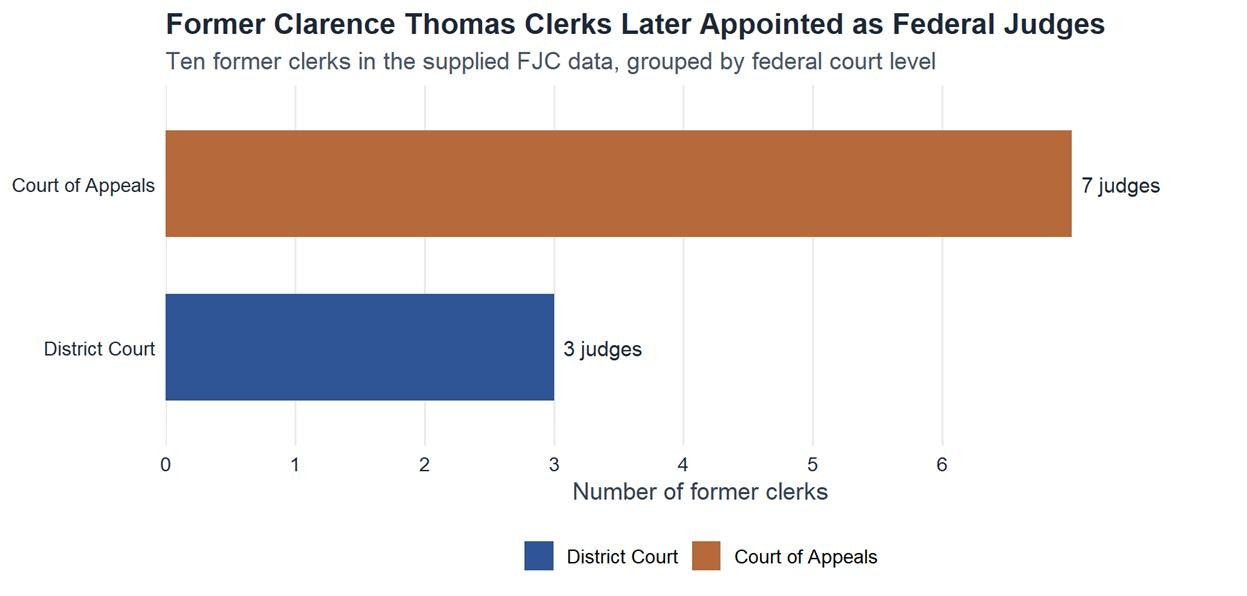
According to data from the FJC, Thomas’s influence also extends through the federal judiciary by way of his former clerks. In the data provided here, 10 former Thomas clerks later became federal judges: Allison Eid, James Ho, Gregory Katsas, Eric Miller, Kathryn Kimball Mizelle, Carl Nichols, Martha Pacold, Neomi Rao, Allison Rushing, and David Stras. Six were appointed to federal courts of appeals, while four were appointed to federal district courts. The appellate appointments span several influential courts — the D.C., 4th, 5th, 8th, 9th, and 10th Circuits — while the district-court appointments include the District of Columbia, the Middle District of Florida, and the Northern District of Illinois. One notable feature of the group is timing: all 10 were appointed by President Donald Trump, meaning Thomas’s clerk network became especially visible during the 2017–2020 wave of Republican judicial appointments. The group also reflects the broader conservative legal pipeline: several had prior clerkships with prominent conservative appellate judges, service in state solicitor general offices or the Justice Department, academic posts, or state supreme court experience before joining the federal bench.
11) Opinion Assignments
Thomas’s role in assigning majority opinions is a quieter but important measure of institutional power. Opinion assignment usually belongs to the chief justice when the chief is in the majority; when the chief is in dissent, the assignment goes to the most senior justice in the majority. That rule has limited Thomas’s opportunities for much of his career. Before he became the most senior associate justice, he could assign only when Chief Justice Roberts was in dissent and every justice senior to Thomas was either also in dissent or no longer on the court. Even now, although Thomas is the most senior justice, he is often aligned with Roberts, which means the chief frequently retains the assignment power in the cases where Thomas is also in the majority.
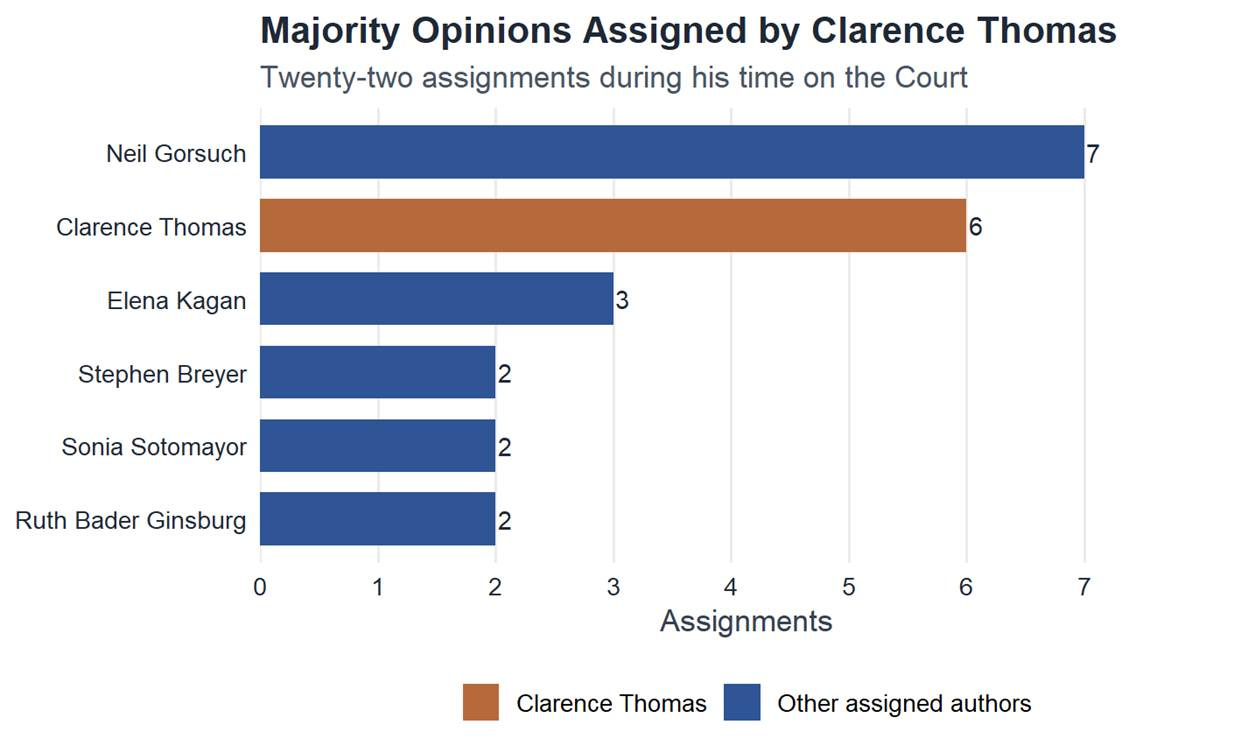
Thomas has assigned 22 majority opinions so far. His first assignment came in the 2009 term in Dolan v. United States, where Justice Breyer wrote for a majority joined by Thomas, Ginsburg, Alito, and Sotomayor, while Chief Justice Roberts dissented with Stevens, Scalia, and Kennedy. That lineup is a clean example of the assignment rule in operation: the chief was in dissent, and the justices senior to Thomas were also outside the majority, leaving Thomas as the senior justice in the majority. His most recent assignment came in the 2024 term in EPA v. Calumet, where Gorsuch and Roberts dissented. Across the 22 assignments, Thomas has assigned seven opinions to Neil Gorsuch, five to himself, three to Elena Kagan, two each to Stephen Breyer, Ruth Bader Ginsburg, and Sonia Sotomayor, and one to no other listed justice beyond those totals. The pattern is revealing: Thomas has used assignment power not only for ideologically predictable conservative opinions, but also for cross-ideological majorities in which liberal justices such as Breyer, Ginsburg, Kagan, and Sotomayor wrote for the court.
Taken together, the data points in this profile show a justice whose influence cannot be captured by any single measure. Thomas is historically long-serving, unusually willing to write alone, central to major doctrinal shifts, and increasingly positioned to shape opinion assignments when the chief justice is not in the majority. But the assignment data also points to a broader theme of his tenure: Thomas’s power has often been indirect, accumulating over time through separate writings, clerk networks, coalition patterns, and the gradual movement of the court toward positions he advanced long before they commanded a majority.
Another fascinating foray! Imagine my surprise to discover that Thomas is but three years older than I … and far more bitter.
Ironically, it might be said that he was nominated for the Negro Seat, once occupied by Thurgood Marshall — the ultimate DEI hire.
Thank you for this very interesting profile on Justice Thomas's impact. Would it be possible for you to re-post the graphic showing the "most frequent agreement" data in #5? It seems to have been cropped too closely on the right-hand side, and the "n=???" data for Justice Barrett is not visible.